Single Strand Necklace with Disk Beads
ca. 1390–1352 B.C.E.


1 of 2
Object Label
Necklaces
Most ancient Egyptians owned at least one necklace.
The simplest examples were made of tiny beads of shell, bone, faience, metal, or glazed steatite. More complex versions had beads in the form of amulets, including uraeus-cobras, wedjat-eyes (the eye of the falcon-god Horus, symbolizing wholeness), scarabs (charms in the form of beetles), or images of gods such as Hathor. Individual beads as well as complete necklaces had significance. Beads reproducing fruits or flowers, such as the examples in this case, were believed to enhance fertility. Military officers presented fly necklaces to valiant soldiers to acknowledge their tenacity in battle.
Most ancient Egyptians owned at least one necklace.
The simplest examples were made of tiny beads of shell, bone, faience, metal, or glazed steatite. More complex versions had beads in the form of amulets, including uraeus-cobras, wedjat-eyes (the eye of the falcon-god Horus, symbolizing wholeness), scarabs (charms in the form of beetles), or images of gods such as Hathor. Individual beads as well as complete necklaces had significance. Beads reproducing fruits or flowers, such as the examples in this case, were believed to enhance fertility. Military officers presented fly necklaces to valiant soldiers to acknowledge their tenacity in battle.
Caption
Single Strand Necklace with Disk Beads, ca. 1390–1352 B.C.E.. Faience, 22 7/16 in. (57 cm). Brooklyn Museum, Gift of Mrs. Lawrence Coolidge and Mrs. Robert Woods Bliss, and the Charles Edwin Wilbour Fund, 48.66.55. (Photo: Brooklyn Museum)
Title
Single Strand Necklace with Disk Beads
Date
ca. 1390–1352 B.C.E.
Dynasty
late Dynasty 18
Period
New Kingdom
Medium
Faience
Classification
Dimensions
22 7/16 in. (57 cm)
Credit Line
Gift of Mrs. Lawrence Coolidge and Mrs. Robert Woods Bliss, and the Charles Edwin Wilbour Fund
Accession Number
48.66.55
Frequent Art Questions
Tell me more.
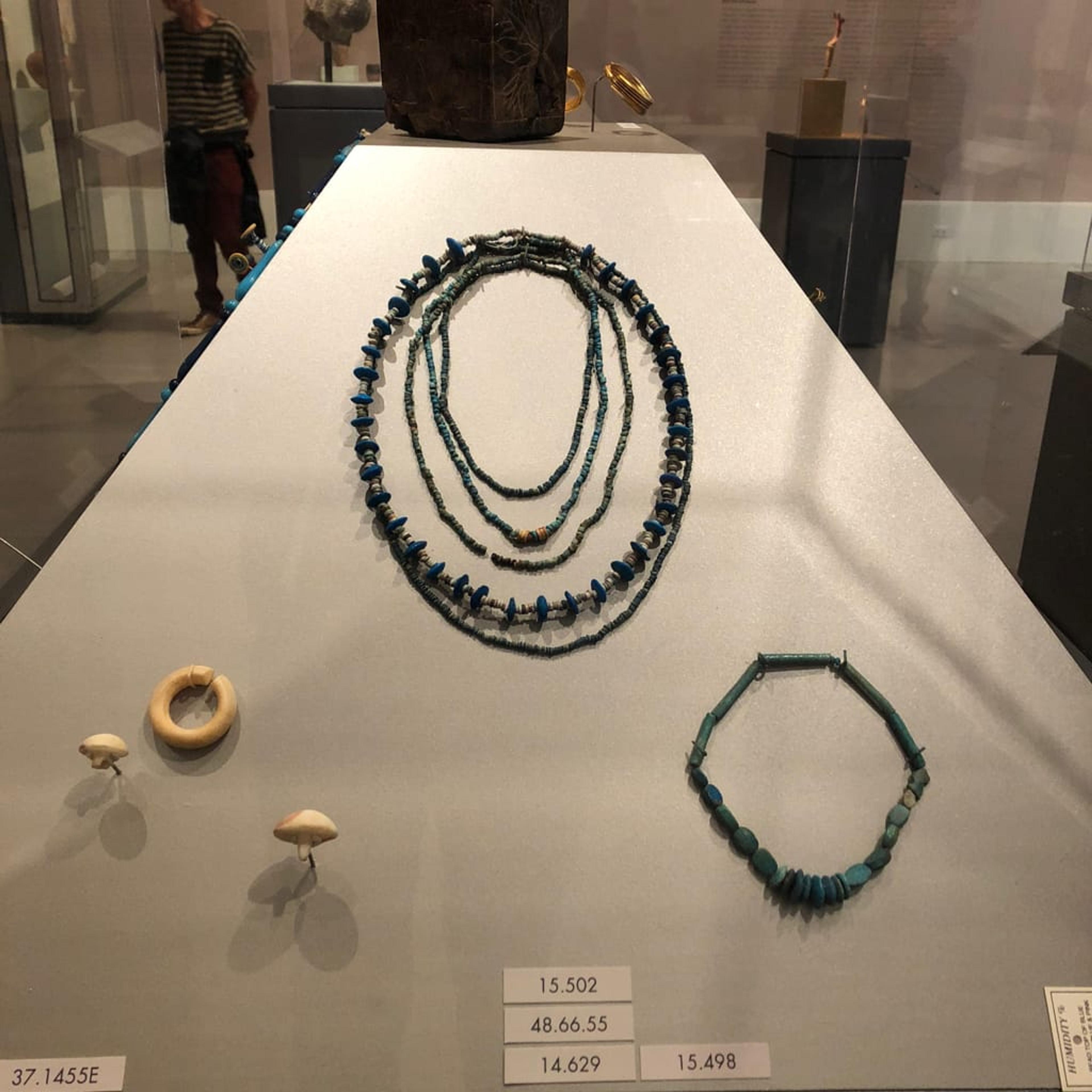 Theses lovely pieces would have served as jewelry much like we were today. Beaded necklaces of faience were particularly popular.Using faience was an affordable alternative to the more precious lapis lazuli. The blue color has symbolic meaning as well! It was connected to the Nile, whose annual floods made life in the desert possible!
Have information?
Have information about an artwork? Contact us at