Falcon-Headed Sun-God

Brooklyn Museum photograph
Object Label
Egyptian religion frequently adopted a mulitplicity of approaches to explain or represent different aspects of a single divine concept. The sun god, for instance, had a morning aspect called Khepri, commonly depicted as a scarab beetle pushing the sun disk across the heavens much as a beetle rolls a ball of dung across the desert floor. The noontime sun was Re or Re-Horakhty, often shown as a falcon or falcon-headed man with a sun disk on his head. Atum, who personified the sun that set over the western horizon to travel through the underworld, could be represented in many guises, including those of a human-headed cobra, a ram-headed man, or a weary old man.
Caption
Falcon-Headed Sun-God, ca. 100–30 B.C.E.. Bronze, gold, 4 15/16 in. (12.6 cm). Brooklyn Museum, Charles Edwin Wilbour Fund, 51.147.1. (Photo: Brooklyn Museum)
Title
Falcon-Headed Sun-God
Date
ca. 100–30 B.C.E.
Period
Ptolemaic Period (probably)
Geography
Place found: Tuna el-Gebel, Egypt
Medium
Bronze, gold
Classification
Dimensions
4 15/16 in. (12.6 cm)
Credit Line
Charles Edwin Wilbour Fund
Accession Number
51.147.1
Frequent Art Questions
Which god is this?
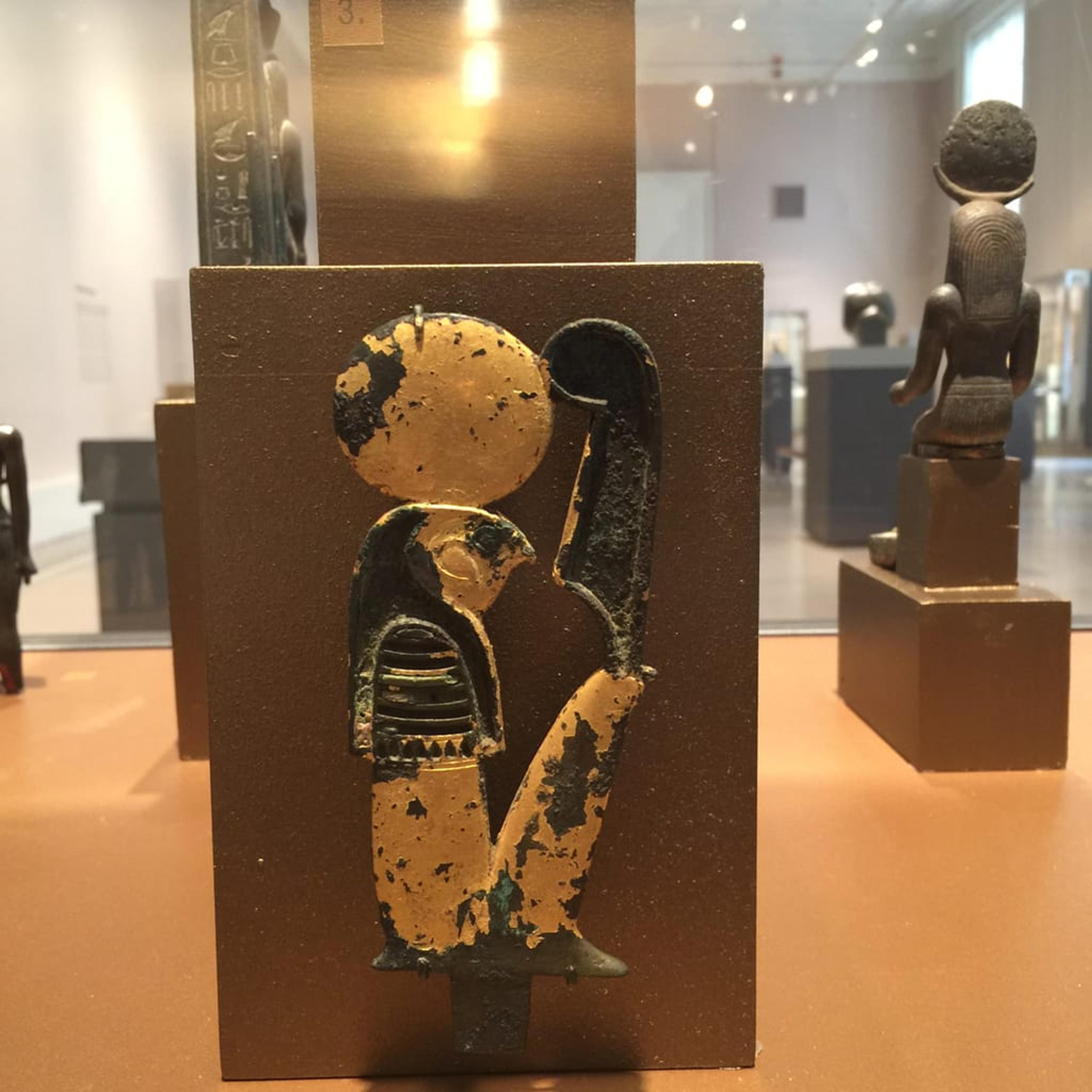 It is most likely Re or Re-Horakhty. There were a few deities in ancient Egypt associated with the sun and a lot of them shared similar traits like the falcon head and the sun-disk headdress.The feather on his knee, which is a symbol of Maat or truth and balance makes me, personally, lean towards Re-Horakhty. Unfortunately, this one did come with an inscription to let us know for sure!Cool, thanks!
Have information?
Have information about an artwork? Contact us at