Antelopes


1 of 5
Object Label
The scene to which this block once belonged probably showed a desert hunting party. The hunters, Akhenaten and his entourage, would have appeared in chariots bearing down on their helpless prey. Their approach has not gone unnoticed: the ears of the two bubalis antelopes perk up at the sound of danger. The back of a third antelope may be seen in the lower right corner. Such isolated blocks provide a hint of the complex decorative schemes that once existed in the palace at el Amarna.
Caption
Antelopes, ca. 1352–1336 B.C.E.. Limestone, pigment, 20 11/16 x 8 7/8 in. (52.5 x 22.5 cm). Brooklyn Museum, Charles Edwin Wilbour Fund, 60.197.5. (Photo: Brooklyn Museum)
Gallery
Not on view
Gallery
Not on view
Title
Antelopes
Date
ca. 1352–1336 B.C.E.
Dynasty
late Dynasty 18
Period
New Kingdom, Amarna Period
Geography
Place found: Hermopolis, Egypt, Place made: Tell el-Amarna, Egypt
Medium
Limestone, pigment
Classification
Dimensions
20 11/16 x 8 7/8 in. (52.5 x 22.5 cm)
Credit Line
Charles Edwin Wilbour Fund
Accession Number
60.197.5
Frequent Art Questions
Are the red markings that highlight the images in the relief put there later or when they were originally made?
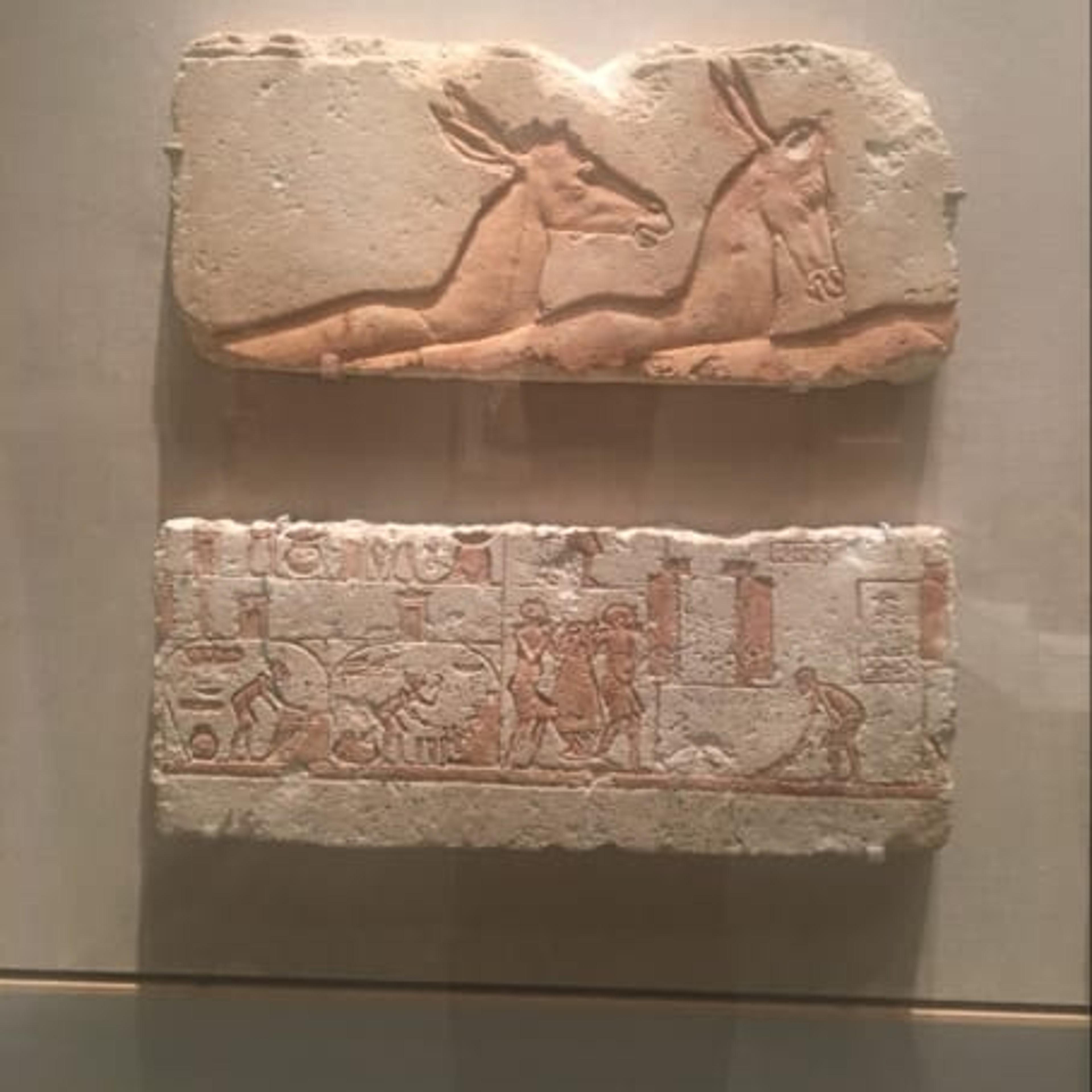 It is all original. Most reliefs, were brightly painted in Ancient Egypt. But unlike the stone its painted on, fragile paint pigments don't always to survive well over thousands of years, so they come to us lacking much of their original bright paint.So these colors probably represent their skin color?Good question: Skin color was indicated with colors, yes, with men typically painted red, and women painted yellowish-white. That doesn't help us pinpoint what actual Egyptians looked like because this was clearly just a convention - real Egyptian women weren't paper-white, nor were the men really bright red.
Have information?
Have information about an artwork? Contact us at