Head of a Man with Tight, Curly Hair
Ancient Near Eastern


1 of 4
Object Label
Changing Faces of the Ancient Nile Valley
Despite the common belief that Egyptian artists were reluctant to change, close examination of works produced over many generations shows that they could be quite innovative in artistic style— the distinctive features of aesthetic expression characterizing a period.
The chief royal sculptor, responsible for official images of the king, usually developed at least one standard “court style.” But styles often varied from one dynasty to the next, and two or more styles often evolved during a single dynasty or even a single reign.
Several forces could result in a new style. A pharaoh’s death could motivate the chief royal sculptor to devise a fresh “standard” for depicting his successor. The replacement of one chief sculptor by another might also inspire innovation. Or perhaps young carvers reacted to the teachings of the chief sculptor, introducing subtle modifications that, over time, became an entirely new style.
The carved heads in this case and in the one on the right, spanning more than three thousand years, demonstrate clear changes in stylistic expression.
Despite the common belief that Egyptian artists were reluctant to change, close examination of works produced over many generations shows that they could be quite innovative in artistic style— the distinctive features of aesthetic expression characterizing a period.
The chief royal sculptor, responsible for official images of the king, usually developed at least one standard “court style.” But styles often varied from one dynasty to the next, and two or more styles often evolved during a single dynasty or even a single reign.
Several forces could result in a new style. A pharaoh’s death could motivate the chief royal sculptor to devise a fresh “standard” for depicting his successor. The replacement of one chief sculptor by another might also inspire innovation. Or perhaps young carvers reacted to the teachings of the chief sculptor, introducing subtle modifications that, over time, became an entirely new style.
The carved heads in this case and in the one on the right, spanning more than three thousand years, demonstrate clear changes in stylistic expression.
Caption
Ancient Near Eastern. Head of a Man with Tight, Curly Hair, late 2nd century B.C.E.. Marble, "Bigio Morata", 11 x 7 11/16 x 7 1/2 in. (28 x 19.5 x 19 cm). Brooklyn Museum, Charles Edwin Wilbour Fund, 70.59. (Photo: Brooklyn Museum)
Culture
Title
Head of a Man with Tight, Curly Hair
Date
late 2nd century B.C.E.
Period
Ptolemaic Period
Geography
Possible place made: Turkey, Place made: Eastern Mediterranean Region
Medium
Marble, "Bigio Morata"
Classification
Dimensions
11 x 7 11/16 x 7 1/2 in. (28 x 19.5 x 19 cm)
Credit Line
Charles Edwin Wilbour Fund
Accession Number
70.59
Frequent Art Questions
Tell me more.
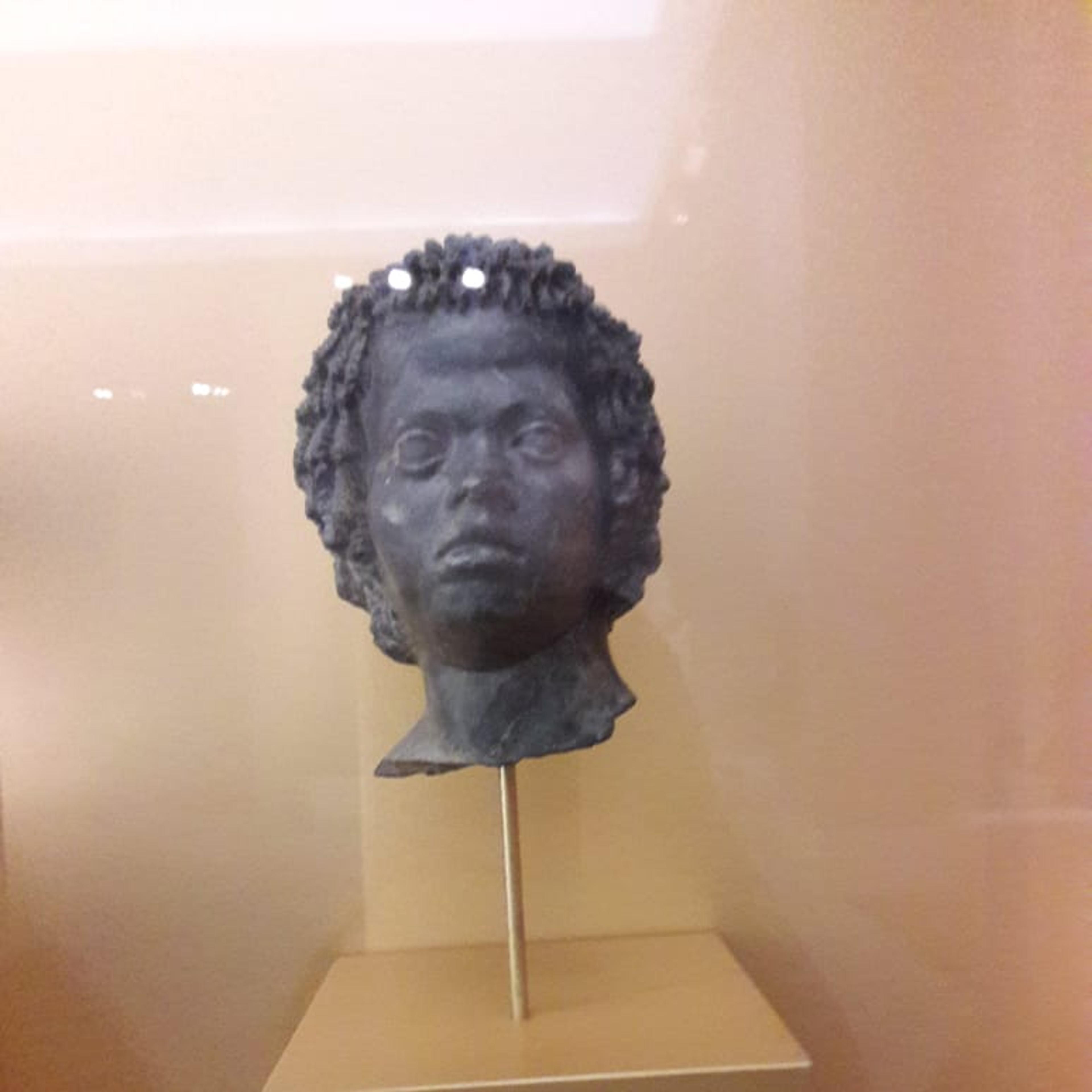 The figure in this sculpture is identified as a Nubian, belonging to a region along the Nile near Egypt. In fact, this object was not actually made in Egypt, but features a Subsaharan african subject in a Hellenistic style. Egypt connected these two disparate places!
Have information?
Have information about an artwork? Contact us at