What a Tailor Can Do! (Lo que puede un sastre!)

Object Label
The most famous image, The Sleep of Reason Produces Monsters (El sueño de la razon produce monstruos), conveys a purposeful ambiguity regarding the conflict between Spanish religiosity and Enlightenment thought: sueño may refer both to the sleep or absence of reason, and to the dream of reason (reason unchecked) that produces monsters. This idea reappears later in the exhibition in Robert Longo’s work.
Caption
Francisco de Goya y Lucientes (Spanish, 1746–1828). What a Tailor Can Do! (Lo que puede un sastre!), 1797–1798. Etching and aquatint on laid paper, Sheet: 11 7/8 x 8 in. (30.2 x 20.3 cm) Image: 7 11/16 x 4 7/8 in. (19.5 x 12.4 cm). Brooklyn Museum, A. Augustus Healy Fund, Frank L. Babbott Fund, and Carll H. de Silver Fund, 37.33.52.
Gallery
Not on view
Gallery
Not on view
Title
What a Tailor Can Do! (Lo que puede un sastre!)
Portfolio
Date
1797–1798
Geography
Place made: Spain
Medium
Etching and aquatint on laid paper
Classification
Dimensions
Sheet: 11 7/8 x 8 in. (30.2 x 20.3 cm) Image: 7 11/16 x 4 7/8 in. (19.5 x 12.4 cm)
Inscriptions
Upper right in plate: "52."; lower center in plate: "Lo que puede un sastre."
Credit Line
A. Augustus Healy Fund, Frank L. Babbott Fund, and Carll H. de Silver Fund
Accession Number
37.33.52
Frequent Art Questions
Tell me more.
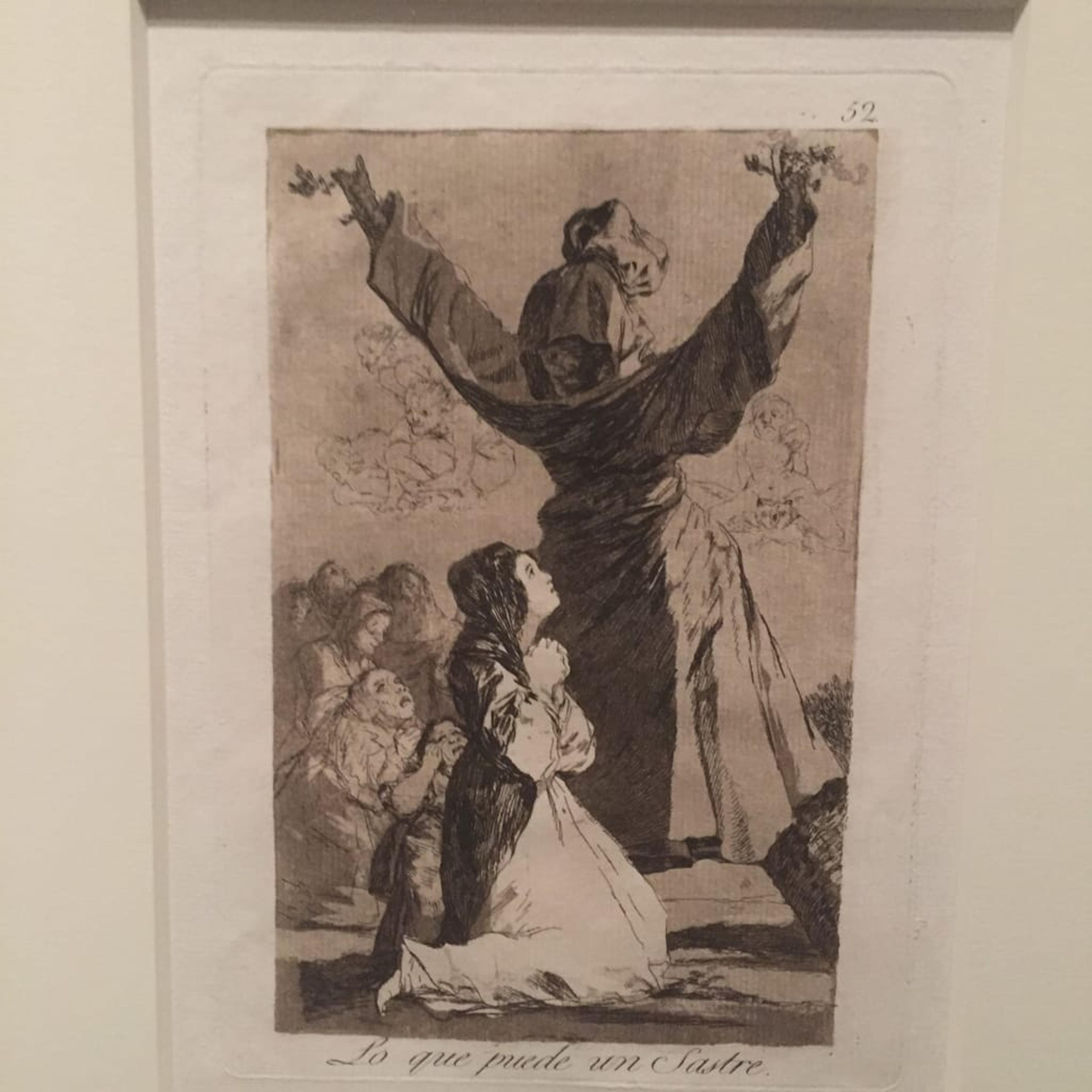 This is "Lo que puede un sastre" or "What a tailor can do," a print from Goya's "Los Caprichos" series. In this image, a young woman kneels before a cloaked figure, dressed as a friar. You might have noticed, however, that the cloaked figure's hands are branches: the woman is really kneeling before a tree dressed as a friar!Thank you so much!You're so welcome! I love chatting about Goya! What drew you to these prints in particular?Mostly the absurdity of them - I saw the entire series at the PMA but when viewing all of the series at once, I glazed over a few and Proof has me seeing them in different a different light.It's definitely worth taking the time to look at each individually! Our collection of "Los Caprichos" is actually an edition of more experimental artist proofs, so they may be a bit different from those you've seen before.
Can you please describe Francisco de Goya y Lucientes’s etching process/practice?
Goya made his etching in the manner that is still fairly standard today. He would first use a hard ground (a layer of wax heat cured on the copper plate) which he would incise the main lines of the drawing into with an etching needle. The areas that he drew on with the needle would be exposed, while the hard ground would protect all the covered areas, and then the plate would be etched in acid for an amount of time chosen by the artist, at which point the lines would be eaten away, leaving grooves in the copper to receive ink. Longer exposure to acid would result in deeper grooves.Once the hard-ground was removed, the plate could be inked and printed using a press. The indents in the metal would hold the ink and the remaining surface would be clean of ink.Goya would often also scratch lines directly into the metal plate's surface with an etching needle, leaving lines with fuzzier edges. This is called drypoint.Last but not least, he was a master of aquatint. Aquatint is a variation on etching that allowed him to get all those velvety fields of grey and black. To make aquatint, Goya would dust the copper plate evenly with powdered rosin (or resin) and then heat set this. Areas not covered by the dust-like dots of rosin would be eaten away by the acid, while areas covered would be protected.So all those fields of grey and black are actually made up of countless tiny dots of ink!Wow!!!! Thank you!Tell me more.
What a Tailor Can Do! (Lo que puede un sastre!), by Francisco de Goya, shows a tree dressed in the robes of a friar. The young woman kneeling before the figure has been fooled into thinking that the tree is a real member of the clergy. The meaning of the work, as the name suggests, is that though anyone can dress as a clergy member, it doesn't necessarily make them virtuous.In other words, Goya is critiquing corruption in the clergy during the early 19th century in Spain, a theme that shows up throughout his prints.
Have information?
Have information about an artwork? Contact us at