Dog Dancer


1 of 3
Object Label
In the first quarter of the twentieth century, a tradition of watercolor easel painting emerged among Pueblo artists in the Southwest. Awa Tsireh from San Ildefonso Pueblo was known for his stylized and abstracted compositions that depict Pueblo dances. These works appealed to the growing local and international markets, accommodating Anglo patrons’ perception of “authentic” Native art. At the same time, however, artists such as Tsireh created their own cultural representations.
Caption
Awa Tsireh (Alfonso Roybal) (Po–who–ge–oweenge (San Ildefonso Pueblo), 1895–1955). Dog Dancer, 1930s. Black ink and watercolor over graphite on wove paper, 11 1/8 x 14 1/8 in. (28.3 x 35.8 cm). Brooklyn Museum, Dick S. Ramsay Fund, 40.89.
Gallery
Not on view
Collection
Gallery
Not on view
Collection
Title
Dog Dancer
Date
1930s
Geography
Place made: San Ildefonso Pueblo, New Mexico, United States
Medium
Black ink and watercolor over graphite on wove paper
Classification
Dimensions
11 1/8 x 14 1/8 in. (28.3 x 35.8 cm)
Credit Line
Dick S. Ramsay Fund
Accession Number
40.89
Frequent Art Questions
What is the man doing?
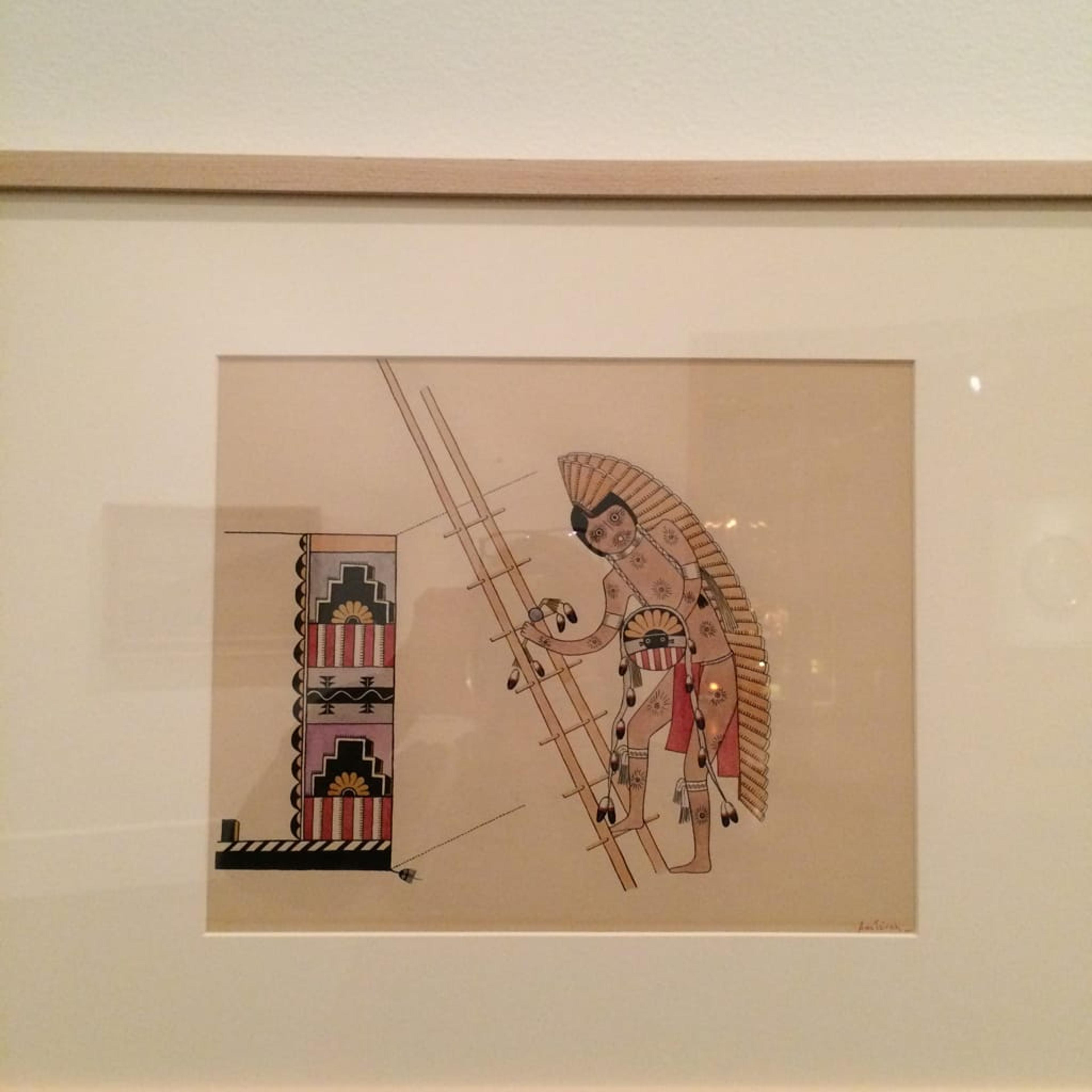 This ledger book drawing is by Tsireh, one of the first pueblo painters to receive recognition by the Santa Fe art community. Here, Awa Tsireh has played with perspective and scale significantly: as kivas are underground, a dancer would be climbing down into or up out of kiva via a small ladder, but here the large ladder seems to be propped against a decorated structure and the direction of travel for the dancer is uncertain.
Have information?
Have information about an artwork? Contact us at