Sauce Dish


1 of 7
Object Label
Caption
Lowestoft Porcelain Factory (1757–ca. 1803). Sauce Dish, late 18th century. Nankeen ware porcelain, Assembled: 6 11/16 x 8 9/16 x 6 5/16 in. (17 x 21.7 x 16 cm) Platter only (a): 7/8 x 8 9/16 x 6 5/16 in. (2.3 x 21.7 x 16 cm) Tureen only (b): 3 7/8 x 7 11/16 x 4 15/16 in. (9.8 x 19.5 x 12.5 cm) Lid only (c): 2 15/16 x 6 1/8 x 4 1/2 in. (7.5 x 15.5 x 11.5 cm). Brooklyn Museum, Gift of Sarah D. Gardiner, 44.139.5a-c. (Photo: Brooklyn Museum)
Gallery
Not on view
Collection
Gallery
Not on view
Collection
Manufacturer
Title
Sauce Dish
Date
late 18th century
Medium
Nankeen ware porcelain
Classification
Dimensions
Assembled: 6 11/16 x 8 9/16 x 6 5/16 in. (17 x 21.7 x 16 cm) Platter only (a): 7/8 x 8 9/16 x 6 5/16 in. (2.3 x 21.7 x 16 cm) Tureen only (b): 3 7/8 x 7 11/16 x 4 15/16 in. (9.8 x 19.5 x 12.5 cm) Lid only (c): 2 15/16 x 6 1/8 x 4 1/2 in. (7.5 x 15.5 x 11.5 cm)
Credit Line
Gift of Sarah D. Gardiner
Accession Number
44.139.5a-c
Frequent Art Questions
Tell me more.
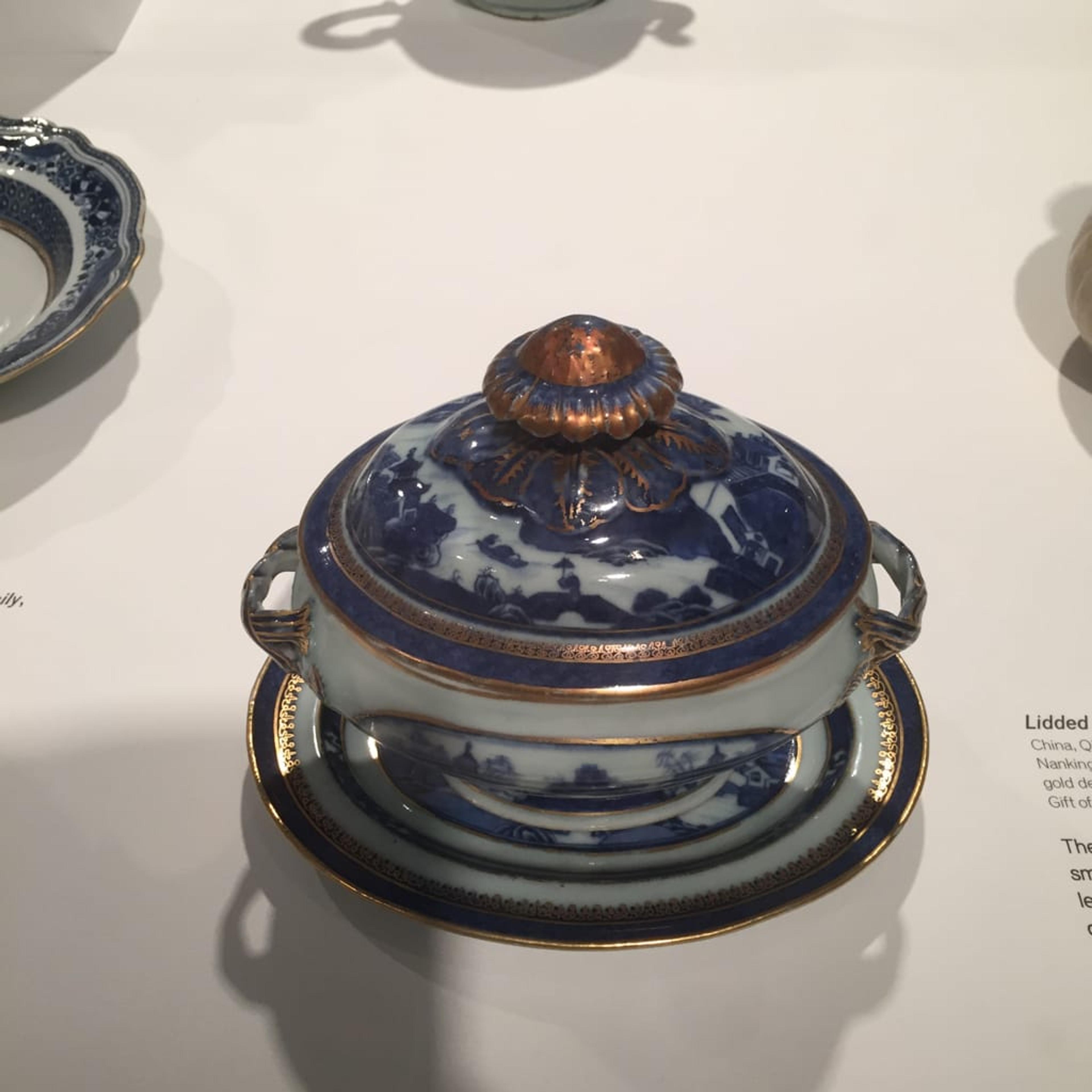 hello. You are looking at a porcelain gravy dish.Although some Asian porcelain reached Europe by overland trade through Venice during the early Renaissance, it was during the sixteenth century that European, especially Dutch, seagoing explorers brought large quantities of Asian blue-and-white porcelain to the West.Europeans were so enamored of these wares that by about 1602, potteries in Delft, the Netherlands, started to produce imitation blue-and-white ceramics. Delft wares were actually earthenware covered with a thick tin-based glaze that imitated the Asian porcelain ceramic body. In Delft, Asian forms and decoration were imitated rather closely, but soon artists began to produce entirely new forms and decorations with Western themes.
Tell me more.
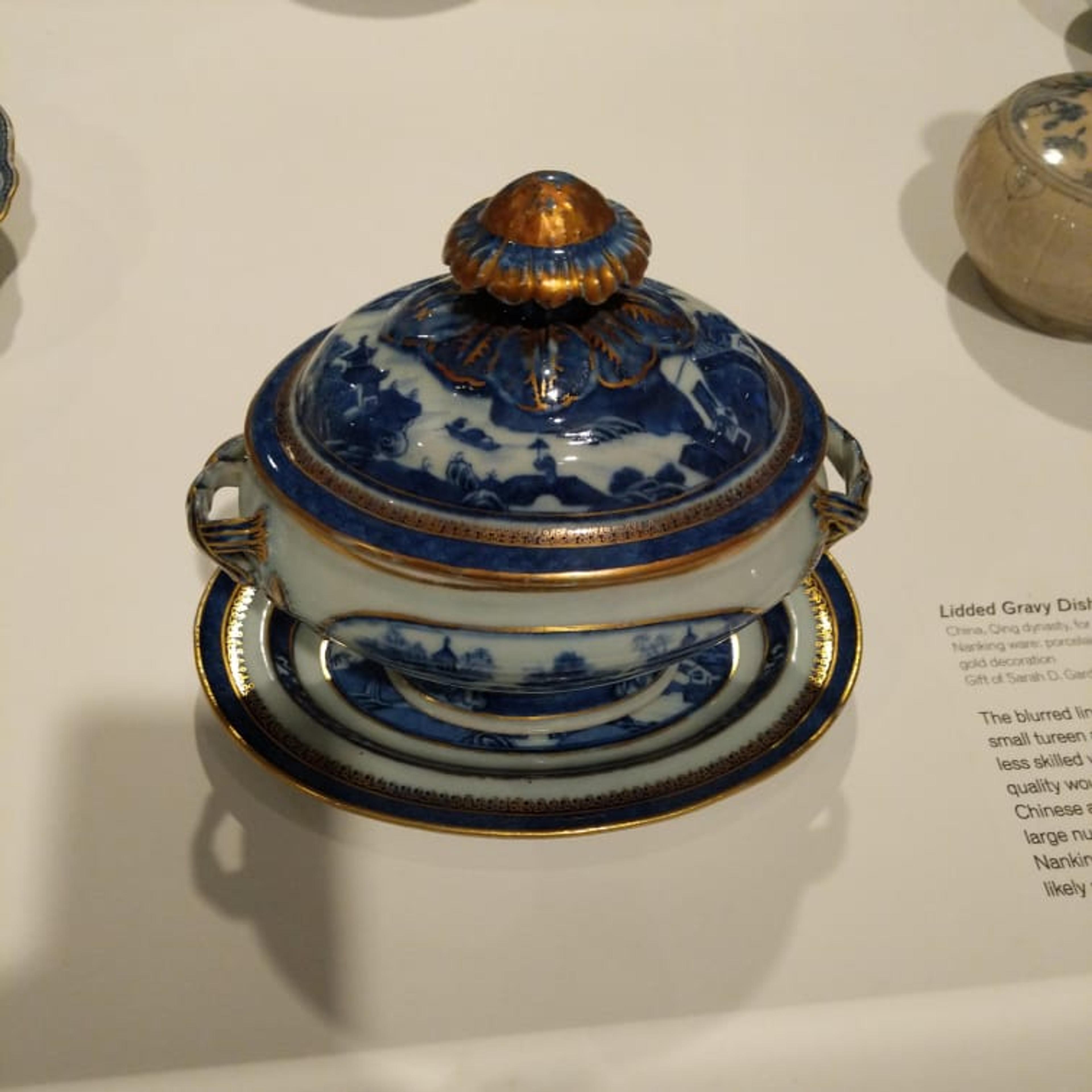 This gravy dish is so beautiful. It is called Nankeen ware porcelain. 'Nankeen' comes fromNanking, or Nanjing, the place in China where this style of porcelain was first produced.Nankeen wares were first imported from China and later copied by European makers and had blue ornament on a white ground.
I was wondering if they used the dish for actual gravy or if it was ornamental?
Great question. The porcelain was completely functional. It was meant to be used (and shown off in the process).As for when, since this is a gravy dish, it would have held gravy during a dinner party. It was meant to show off the wealth and sophistication of the owner hosting the dinner.
Have information?
Have information about an artwork? Contact us at