Man and Llama Vessel
Recuay

Brooklyn Museum photograph
Object Label
This vessel may represent a shaman, or ritual specialist, taking a llama to be sacrificed to Pachamama (Mother Earth) or to the mountain spirits (apus). Such ceremonies occur today during the planting and harvesting of crops in order to encourage a fertile season. The shaman, shown in an elaborate headdress and finely woven tunic, holds an ornate panpipe, or antara, whose sound imitates the animal’s cries.
Caption
Recuay. Man and Llama Vessel, 200 B.C.E.–600. Ceramic, pigment, 9 5/16 x 8 1/16 x 3 15/16 in. (23.7 x 20.5 x 10 cm). Brooklyn Museum, Gift of Leo E. Fleischman, 45.175.3. (Photo: Brooklyn Museum)
Gallery
Not on view
Collection
Gallery
Not on view
Collection
Culture
Title
Man and Llama Vessel
Date
200 B.C.E.–600
Geography
Place made: Northern Highlands, Peru
Medium
Ceramic, pigment
Classification
Dimensions
9 5/16 x 8 1/16 x 3 15/16 in. (23.7 x 20.5 x 10 cm)
Credit Line
Gift of Leo E. Fleischman
Accession Number
45.175.3
Frequent Art Questions
Tell me more.
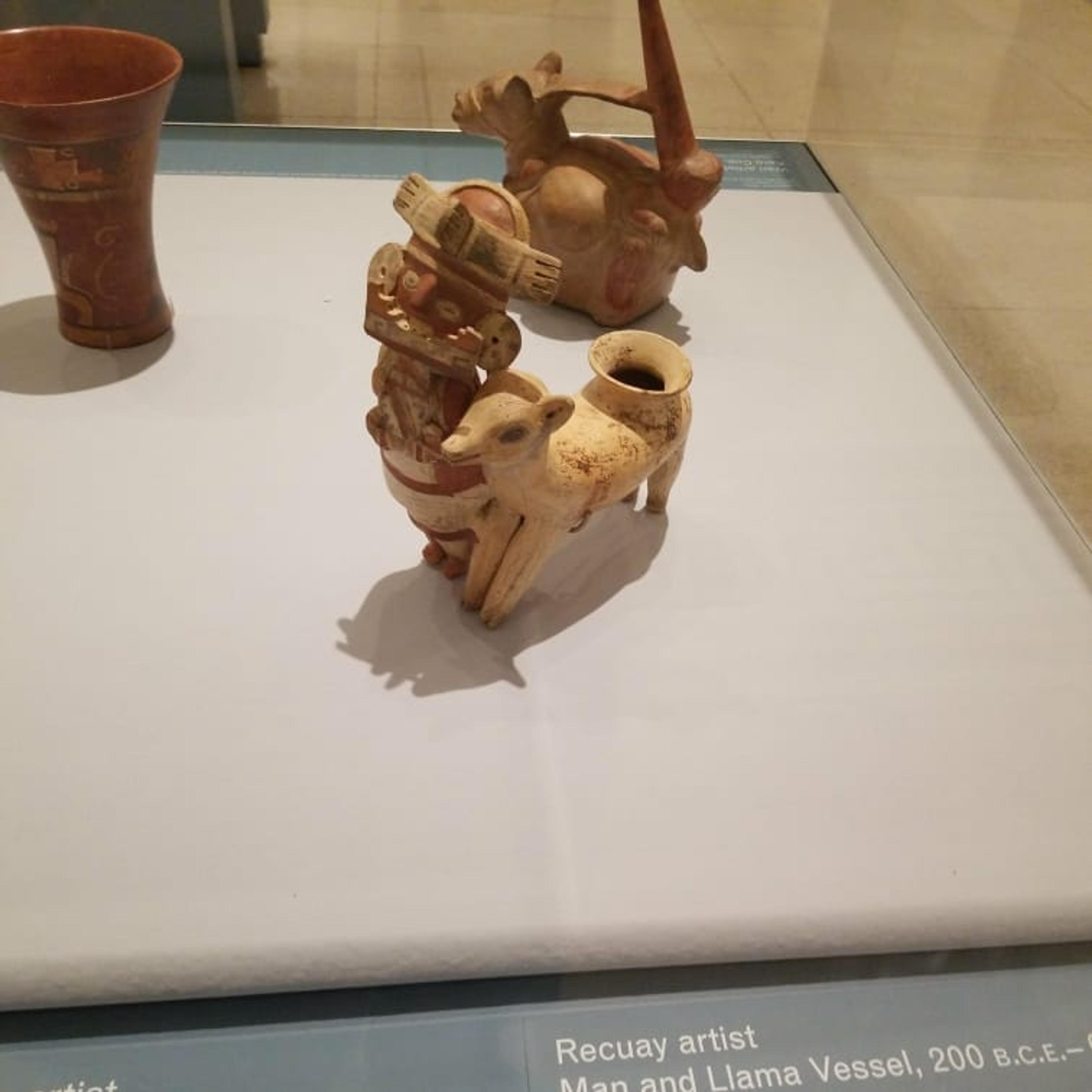 The Recuay culture produced ceramic and stone material culture between 200 B.C.E. and 600 C.E. The man, who may be a shaman, is shown wearing an elaborate headdress and holding a panpipe. Llamas had major significance in various Peruvian cultures as beasts of burden, and sources of wool, and meat. In this case, the shaman may be taking the llama to be sacrificed to the gods.
Have information?
Have information about an artwork? Contact us at