A Back Road
Frederick Childe Hassam

Brooklyn Museum photograph
Object Label
Throughout his career, Frederick Childe Hassam made several extended trips to Europe, where he was inspired by the sights and the many artists he met there. A Back Road, completed the year after his first European tour, demonstrates a compositional daring and freedom of brushwork that were still unusual in American art of this period. Influenced by the work of the nineteenth-century French Barbizon School, Hassam emphasized heavy brushstrokes and intense lighting effects.
During a return visit several years later, Hassam found “a charming old French garden” at Villiers-le-Bel, near Paris. The setting reminded him of Appledore Island off the coast of Maine, home to his friend, the poet Celia Thaxter. Poppies on the Isles of Shoals is one of a number of works painted on Appledore in the years immediately following his Paris sojourn.
During a return visit several years later, Hassam found “a charming old French garden” at Villiers-le-Bel, near Paris. The setting reminded him of Appledore Island off the coast of Maine, home to his friend, the poet Celia Thaxter. Poppies on the Isles of Shoals is one of a number of works painted on Appledore in the years immediately following his Paris sojourn.
Caption
Frederick Childe Hassam (American, 1859–1935). A Back Road, 1884. Oil on canvas, frame: 37 7/8 x 32 x 3 1/4 in. (96.2 x 81.3 x 8.3 cm) 31 x 24 3/4 in. (78.8 x 62.8 cm). Brooklyn Museum, Caroline H. Polhemus Fund, 47.122. (Photo: Brooklyn Museum)
Gallery
Not on view
Collection
Gallery
Not on view
Collection
Artist
Title
A Back Road
Date
1884
Medium
Oil on canvas
Classification
Dimensions
frame: 37 7/8 x 32 x 3 1/4 in. (96.2 x 81.3 x 8.3 cm) 31 x 24 3/4 in. (78.8 x 62.8 cm)
Signatures
Signed lower left: "Childe Hassam/84"
Credit Line
Caroline H. Polhemus Fund
Accession Number
47.122
Frequent Art Questions
The caption text for this painting says the artist was inspired by the works of the French Barbizon school. Can you tell me something about that school of painting?
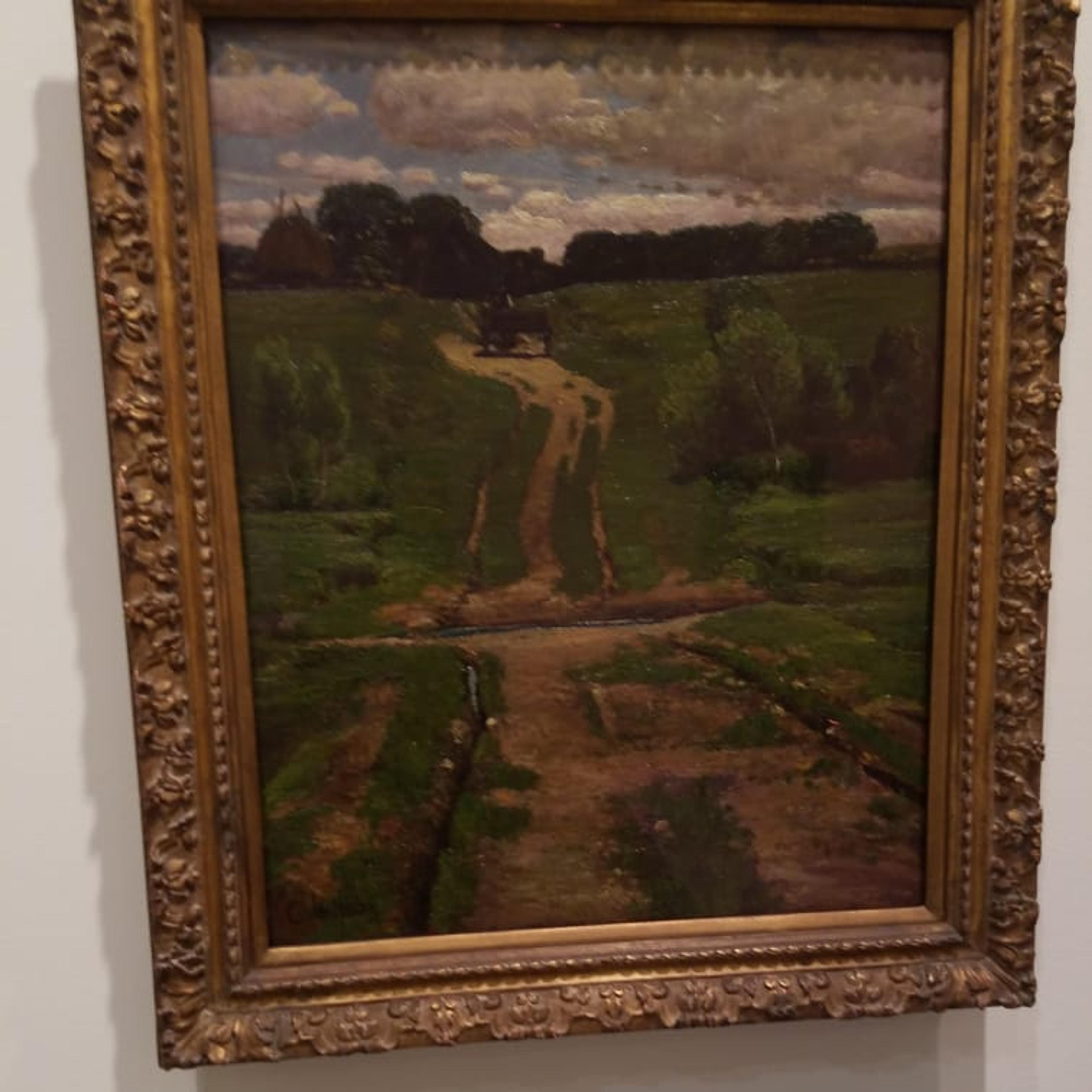 Great question! The French Barbizon school of the mid-1800s was interested in achieving greater naturalism in art, especially in carefully observed scenes of workers, peasants, and rustic landscapes. They often painted in darker tones, with loose brushwork.The Barbizon painters looked at the landscape as an important subject in itself, instead of just using it as a background for stories from myth or history. You may have heard of the painters Jean-François Millet or Theodore Rousseau? They were two of the the best known Barbizon painters.
Have information?
Have information about an artwork? Contact us at