John Van Cortlandt
American

Brooklyn Museum photograph
Object Label
Throughout the Spanish empire and in Europe in general, the lesser nobility and wealthy merchant classes imitated the royal courts in their patronage of the arts, including the commissioning of full-length portraits. Doña María de la Luz (whose adult portrait is also on view in this exhibition) is portrayed here in her Mexico City town house with a toddler’s rattle and a silver-mounted coral pacifier. Despite her young age, the sitter wears an embroidered silk dress in the height of French fashion complemented by a costly pearl necklace and matching earrings and bracelets. In Spanish America, the early eighteenth century saw the rise of the female portrait, which had been nearly nonexistent in seventeenth-century Mexico and Peru.
The painting of John Van Cortlandt, a young member of New York’s Anglo-Dutch elite, is likewise based on a European model, in this case British Grand Manner portraits of the period. The sitter wears a man’s European formal jacket of wool and inhabits a fanciful setting.
The painting of John Van Cortlandt, a young member of New York’s Anglo-Dutch elite, is likewise based on a European model, in this case British Grand Manner portraits of the period. The sitter wears a man’s European formal jacket of wool and inhabits a fanciful setting.
Caption
American. John Van Cortlandt, ca. 1731. Oil on linen, 56 15/16 x 41 9/16 in. (144.7 x 105.6 cm) frame: 64 x 48 1/4 x 3 3/4 in. (162.6 x 122.6 x 9.5 cm). Brooklyn Museum, Dick S. Ramsay Fund, 41.152. (Photo: Brooklyn Museum)
Gallery
Not on view
Collection
Gallery
Not on view
Collection
Culture
Title
John Van Cortlandt
Date
ca. 1731
Geography
Place made: United States
Medium
Oil on linen
Classification
Dimensions
56 15/16 x 41 9/16 in. (144.7 x 105.6 cm) frame: 64 x 48 1/4 x 3 3/4 in. (162.6 x 122.6 x 9.5 cm)
Signatures
Unsigned
Credit Line
Dick S. Ramsay Fund
Accession Number
41.152
Frequent Art Questions
Is there a significance to the fact that some of the portraits have animals in them, but most do not?
For John Van Cortlandt and his family, this white-tailed deer was a symbol of the fauna of the New World. They were making a name for themselves in America and wanted to demonstrate both their strong European roots (with the style of the portrait) as well as distinguish themselves (with the deer).Part of the idea was also that America was more wild than Europe (remember this is 1731) and people lived much closer to nature.Great, thank you very much!Why do they point their index finger?
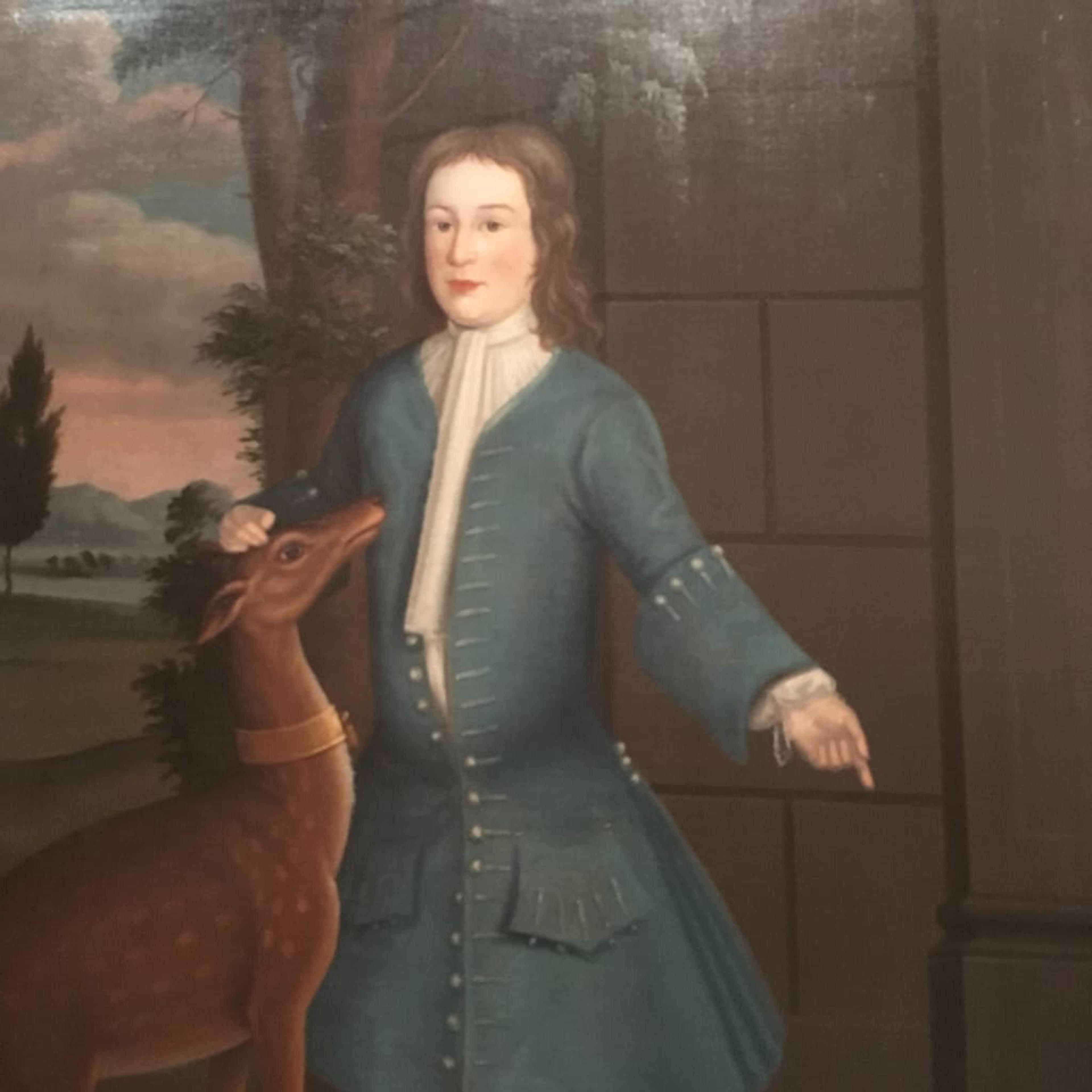 Hi there! Pointing this way is a common pose throughout portraiture in Europe and the European colonies dating back many centuries.I believe it can be traced to ancient Rome when a pointing pose was often a symbol of a statesman or an orator. Some suggest that the direction in which one points might convey their path in life and their level of progression on said path. Let me see what I can confirm.Interesting.If you take a look at the nearby painting of George Washington by Gilbert Stuart you'll see another pose drawn directly Roman images of statesmen. I'm having trouble finding if pointing down has a different connotation, but it certainly built out of the same tradition.Thank you!You're welcome! As you many know, the European art tradition frequently looks to the Classical period for inspiration. There is a gallery of Neo-classical sculpture nearby where you'll see many references to Greek and Roman myth!
Who is this boy?
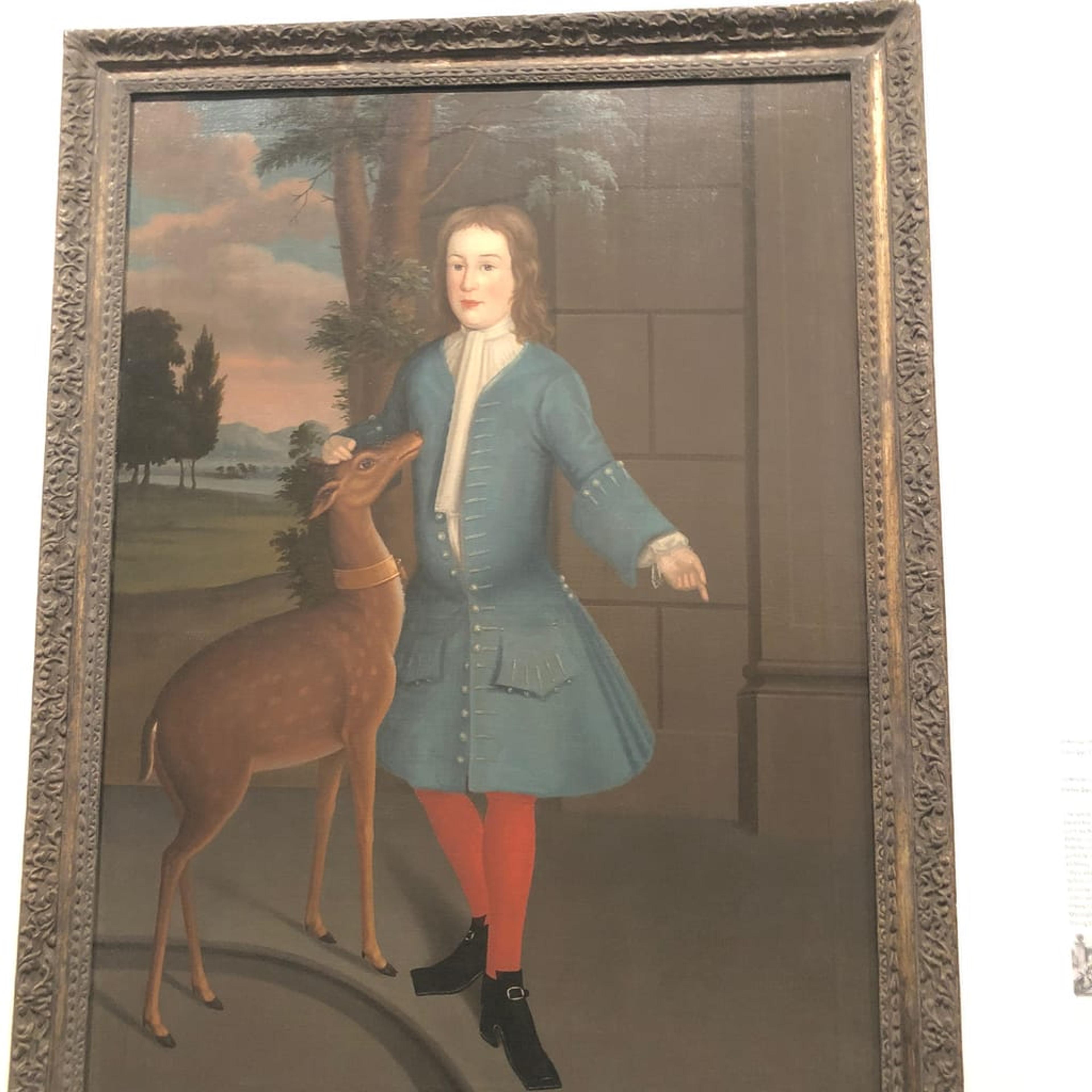 The subject of this portrait, John Van Cortlandt, was about 13 years old when he posed. The Van Cortlandts were one of the city's wealthiest Dutch families and owned large amounts of property north of Manhattan.While the artist is unknown, it's clear they were looking to Mezzotint prints of portraits of British nobility for the pose as well as the setting. These portraits functioned as a status symbol in the home, indicating both wealth and cultural ties to Europe.
Have information?
Have information about an artwork? Contact us at