Moonlight

Brooklyn Museum photograph
Object Label
Ralph Albert Blakelock’s wide-ranging tours of the American West in 1869 and 1871 inspired him to paint Native subjects for many years. He was among the first painters to depart from a “documentary” treatment of Native Americans, choosing instead to describe them in vaguely readable groups set in dark and moody moonlit settings. This approach immediately marked his landscape settings as American but left the story line up to the active imaginations of his late nineteenth-century American audience.
Caption
Ralph Albert Blakelock (American, 1847–1919). Moonlight, ca. 1885–1889. Oil on canvas, 27 1/16 x 32 in. (68.7 x 81.3 cm) frame: 36 9/16 x 41 1/2 x 3 1/4 in. (92.9 x 105.4 x 8.3 cm). Brooklyn Museum, Dick S. Ramsay Fund, 42.171. (Photo: Brooklyn Museum)
Gallery
Not on view
Collection
Gallery
Not on view
Collection
Artist
Title
Moonlight
Date
ca. 1885–1889
Medium
Oil on canvas
Classification
Dimensions
27 1/16 x 32 in. (68.7 x 81.3 cm) frame: 36 9/16 x 41 1/2 x 3 1/4 in. (92.9 x 105.4 x 8.3 cm)
Signatures
Signed lower right (in arrowhead): "R. A. Blakelock"
Credit Line
Dick S. Ramsay Fund
Accession Number
42.171
Frequent Art Questions
What can you tell me about Blakelock. Do you have others in the collection?
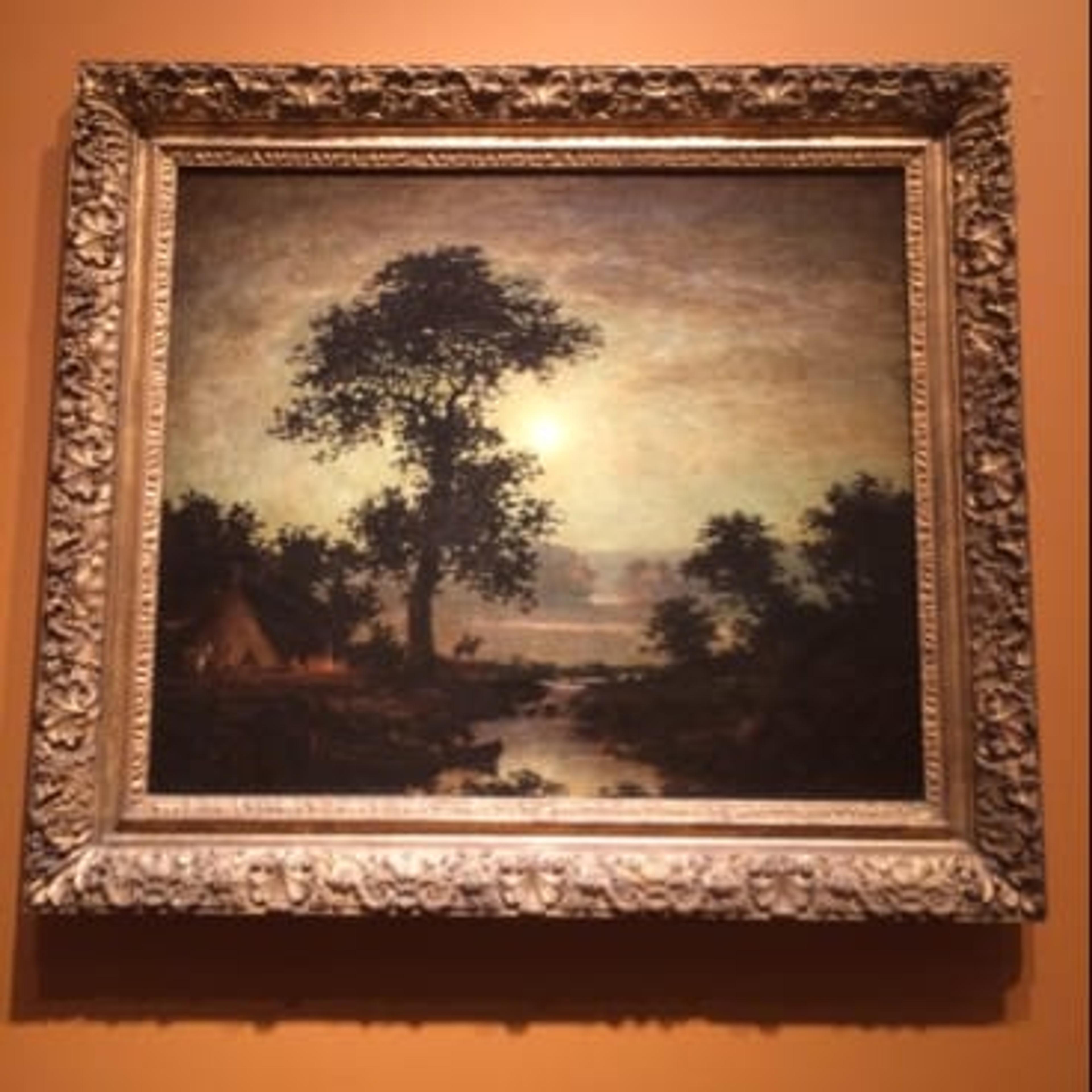 Blakelock! Such a beautiful landscape.Yes, this museum owns about 29 works by Blakelock, including paintings and drawings.In a landscape like this, he's combining European traditions of landscape painting with a uniquely American subject -- the Native Americans at the left (and the lone rider on his horse!).He especially enjoyed painting landscapes in twilight and moonlight.Are any others on display?I believe this is the only work by Blakelock on view in the galleries right now. However, you may be able to spot other paintings by this artist in the Luce Visible Storage area located off the American galleries.Thanks. He was my great-great-grandfather.That's amazing. I'm so glad you are able to spend some time with his art here. I want to do more research on him soon. I think his work is really special.The Brooklyn Museum also owns some of his figure studies, some California landscape drawings, a few more typical moonlight landscapes, a very charming drawing of women playing croquet... a very nice selection.Thanks for all your help.You can also browse the collection from Brooklynmuseum.org at home, at your leisure! Thanks for much for chatting. It was a pleasure to "meet" a member of the artist's family.
Now I am looking at Blakelock’s "Moonlight." The surface seems cracked. Why is that?
With age, most oil paintings do crack. The dry paint, especially with the varnish over it, creates a stiffer surface than the canvas it is painted on. Any fluctuations in the surface will create cracks.Blakelock's work, much like that of Albert Pinkham Ryder, is particularly susceptible to cracking due to experimental use of materials. In "Moonlight," Blakelock alternated numerous medium-rich transparent and pigmented translucent or opaque paint layers. The heavy application of these resin-rich layers has darkened and cracked the painting over time.The label says that his “vague” approach to the figures of the natives, has “marked his landscape settings as American”. Why is that?
 The inclusion of these native people who are clearly from North America (their teepee being a distinct trait of people from the Great Plains region in the middle of the continent) distinguishes this painting from anything that could be considered European.Great thanks!You're welcome!
Have information?
Have information about an artwork? Contact us at