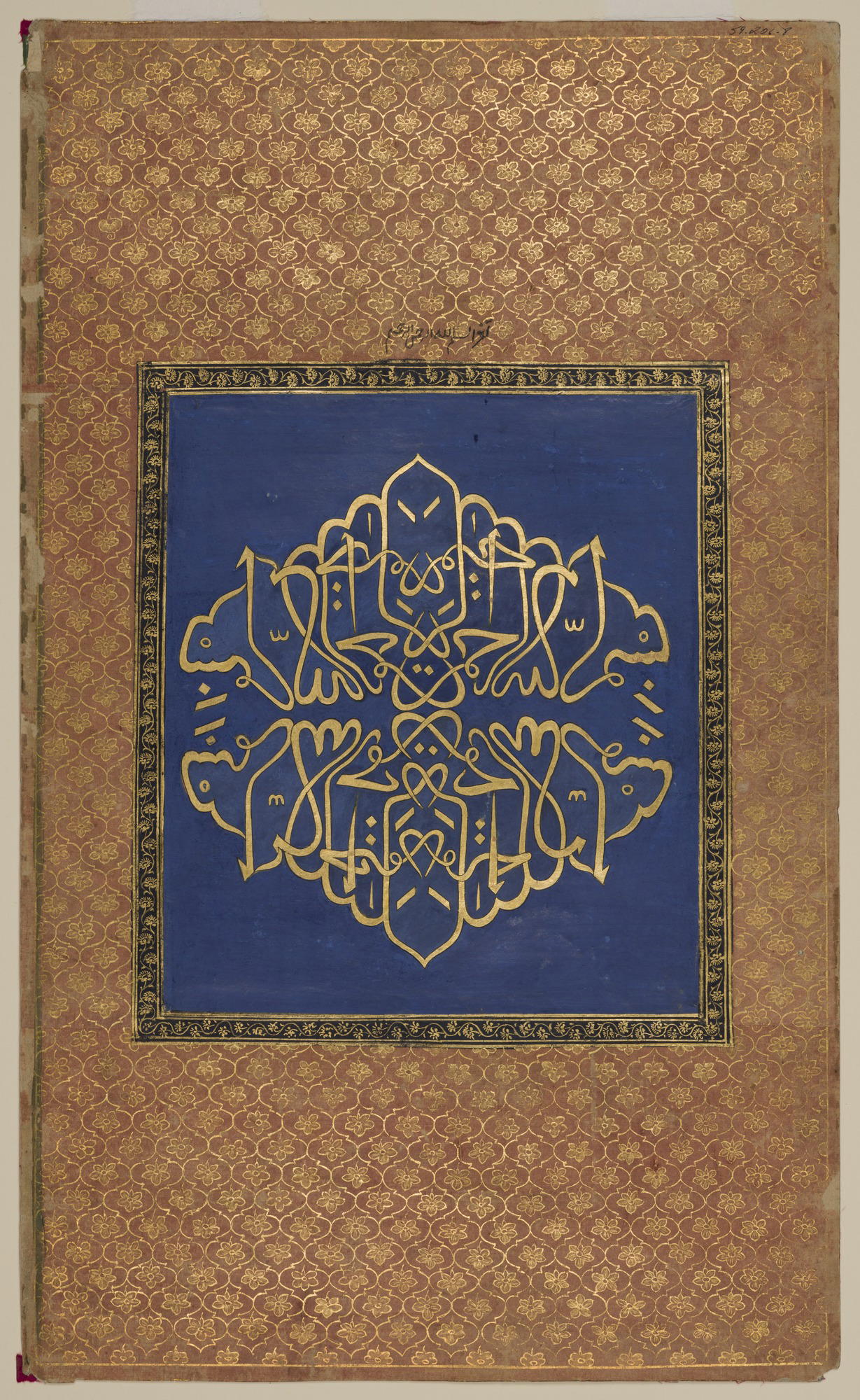
The Bismillah
Brooklyn Museum photograph
Object Label
Caption
Indian. The Bismillah, 1875–1900. Opaque watercolor and gold on paper, sheet: 19 5/8 x 11 13/16 in. (49.8 x 30.0 cm) image: 8 15/16 x 7 5/8 in. (22.8 x 19.4 cm). Brooklyn Museum, Gift of Philip P. Weisberg, 59.206.8. (Photo: Brooklyn Museum)
Gallery
Not on view
Collection
Gallery
Not on view
Collection
Culture
Title
The Bismillah
Date
1875–1900
Geography
Place made: Hyderabad, Deccan, India
Medium
Opaque watercolor and gold on paper
Classification
Dimensions
sheet: 19 5/8 x 11 13/16 in. (49.8 x 30.0 cm) image: 8 15/16 x 7 5/8 in. (22.8 x 19.4 cm)
Inscriptions
Inscriptions: In Persian in black ink above on mount: "Tughra-i bismallah al-rahman al-rahim" from catalogue: Above, in upper border, in Persian, in black ink, in Nastaliq script: Tughva [in this context, a calligraphic emblem] of "In the name of God, the merciful, the compassionate."
Credit Line
Gift of Philip P. Weisberg
Accession Number
59.206.8
Have information?
Have information about an artwork? Contact us at