One of the World’s Only Complete and Gilded Books of the Dead Goes on View for the Very First Time
After a three-year restoration project, the exceptionally rare, 21-foot-long manuscript will be presented in a refreshed funerary gallery in the Brooklyn Museum’s Egyptian wing.
Unrolling Eternity: The Brooklyn Books of the Dead opens January 30, 2026
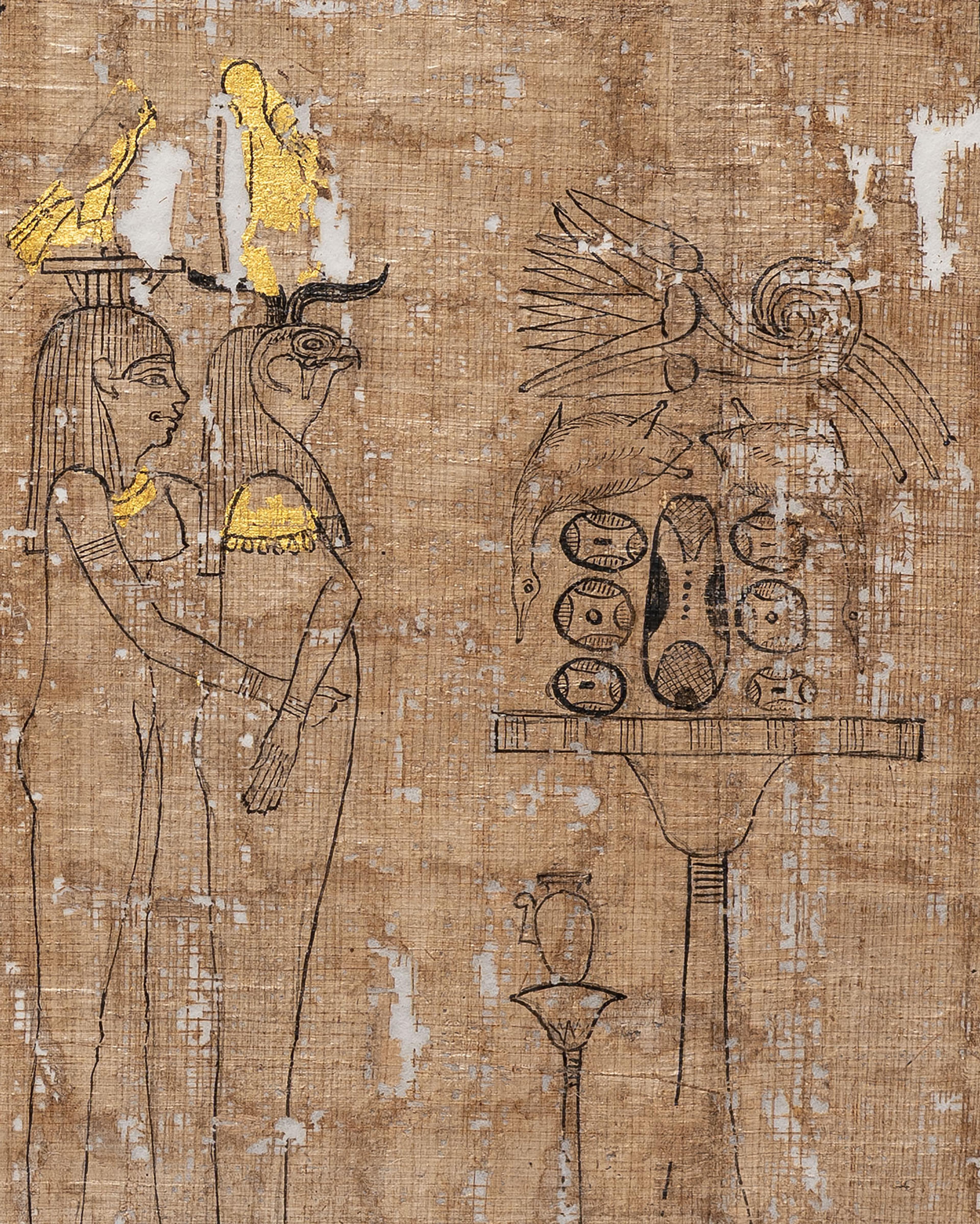
In January 2026, the Brooklyn Museum will unveil one of the world’s rarest treasures: a 21-foot, complete and gilded Book of the Dead (305–30 B.C.E.)–the finest surviving example of its kind. Presented to the public for the very first time following a three-year conservation project, generously supported by the Bank of America Art Conservation Project, the exceptionally rare papyrus will anchor a newly refreshed funerary installation in the Museum’s Ancient Egyptian Art galleries. Filled with gleaming vignettes, the scroll appears alongside one of the earliest Books of the Dead and fascinating artifacts, such as gold amulets and reed pens as well as preparatory sketches. Unrolling Eternity illuminates both ancient burial rites and the artistic prowess behind a rare masterpiece, as well as the cutting-edge techniques used to preserve it.
The restoration of this papyrus, led by conservation specialist Ahmed Tarek and Museum conservators Lisa Bruno, Sara Bone, and Josephine Jenks, represents a major technical and scholarly achievement. Before its arrival at the Museum in 1948, the manuscript had been mounted on an acidic paper backing during an earlier stabilization attempt, leading to ongoing deterioration. Conservation and research also revealed that the papyrus was cut into smaller sections—likely in the 19th century, a common practice at the time—to facilitate mounting. Only about 11 feet of the scroll remained intact, making the detachment and restoration process particularly challenging. In response, Tarek developed a new method to safely remove the delicate manuscript from its degrading backing without causing further damage. After three years of meticulous work and specialized expertise, the team successfully preserved this remarkable artifact.
Books of the Dead are funerary texts from ancient Egypt, written for individuals and filled with personalized spells intended to guide the deceased through the underworld. The newly restored manuscript, dated between 340 and 57 B.C.E., is inscribed in hieratic (cursive hieroglyphs) and decorated with ink vignettes, some gilded with gold. It includes nearly all 162 spells from the most extensive Book of the Dead manuscripts and is composed largely in the Memphite style of Lower Egypt, identifiable by its hieratic script and double outlines around text columns and vignettes. Underdrawings are visible beneath some illustrations and gilding along with traces of yellow orpiment—a once-common decorative mineral pigment—remain. Unlike most surviving papyri, which are often fragmentary, this example includes blank pages at both the beginning and end, confirming its completeness. Conservation and curatorial efforts revealed that it belonged to Ankhmerwer son of Taneferher (“the one beautiful of face”), offering a rare connection to an individual who lived more than two thousand years ago.
“Gilded papyri are incredibly rare. Having one that is complete and of Memphite origin makes it even more extraordinary,” says Yekaterina Barbash, Curator of Egyptian, Classical, and Ancient Near Eastern Art. “Very few scholars in the field of Book of the Dead studies have had the pleasure of seeing even a fragmentary gilded manuscript. We’re so excited to bring this complete masterpiece to Brooklyn Museum audiences.”
“Cultural institutions are essential partners in our communities, sharing historic works and artifacts with New Yorkers of all ages,” said José Tavarez, president, Bank of America New York City. "Private sector support for art conservation helps ensure that vulnerable artwork and archaeological pieces like Book of the Dead are preserved for future generations. Newly restored with Bank of America Art Conservation Project funding, Book of the Dead will offer Brooklyn Museum visitors the opportunity to experience ancient Egyptian funerary customs in a new light."
Bank of America Art Conservation Project is a global and unique program that provides grants to nonprofit cultural institutions to conserve significant woks of arts. Since 2010, the program has supported the preservation of more than 275 projects across 40 countries, including three in the Brooklyn Museum.
On view as part of the newly refreshed galleries are the elaborately decorated coffin and mummy board of Pasebakhaienipet, mayor of Thebes; wall reliefs from the tomb of the vizier Nespeqashuty; several mummified individuals and animals; and one of the earliest-known Books of the Dead (1500–1480 B.C.E.). A selection of two- and three-dimensional sculpture, paintings, and smaller objects in the gallery further illustrate ancient Egyptian afterlife beliefs and practices.
Credits
Unrolling Eternity: The Brooklyn Books of the Dead is organized by Yekaterina Barbash, Curator, with Morgan Moroney, Assistant Curator, and Kathy Zurek-Doule, Curatorial Associate, Egyptian, Classical, and Ancient Near Eastern Art.
Funding for the conservation of the illustrated Book of the Dead was generously provided through a grant from the Bank of America Art Conservation Project.
About the Brooklyn Museum
For 200 years, the Brooklyn Museum has been recognized as a trailblazer. Through a vast array of exhibitions, public programs, and community-centered initiatives, it continues to broaden the narratives of art, uplift a multitude of voices, and center creative expression within important dialogues of the day. Housed in a landmark building in the heart of Brooklyn, the Museum is home to an astounding encyclopedic collection of more than 140,000 objects representing cultures worldwide and over 6,000 years of history—from ancient Egyptian masterpieces to significant American works, to groundbreaking installations presented in the only feminist art center of its kind. As one of the oldest and largest art museums in the country, the Brooklyn Museum remains committed to innovation, creating compelling experiences for its communities and celebrating the power of art to inspire awe, conversation, and joy.