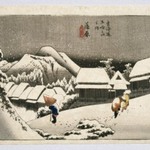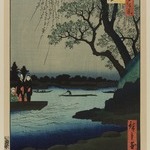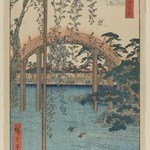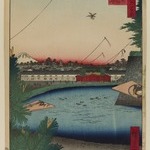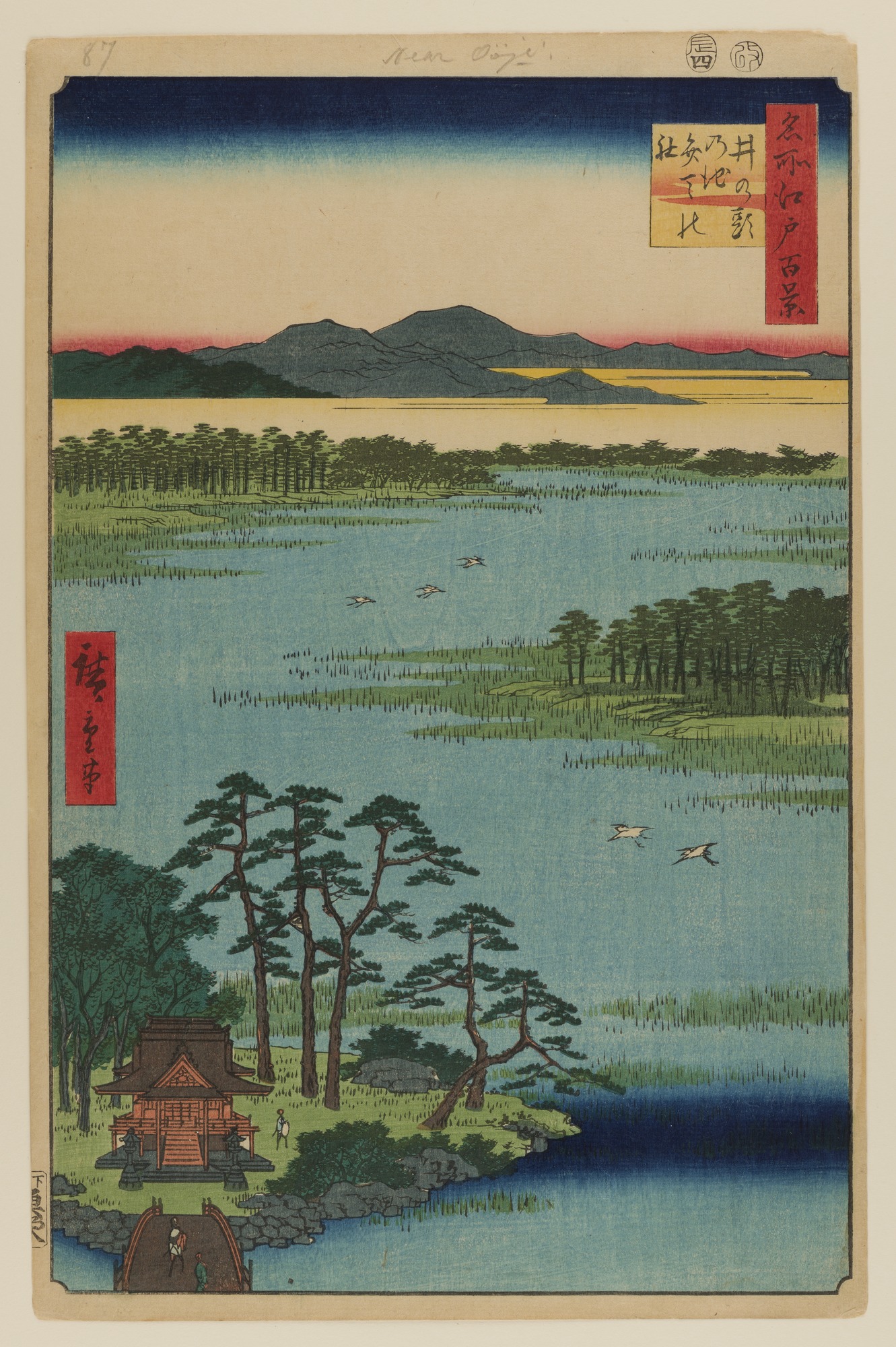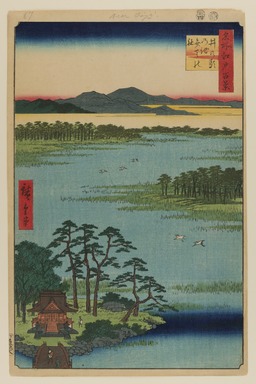
Benten Shrine, Inokashira Pond, No. 87 from One Hundred Famous Views of Edo
Utagawa Hiroshige
Asian Art
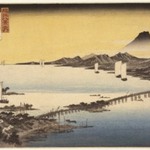
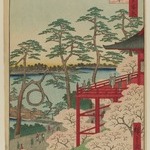
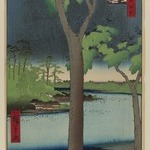
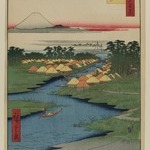
Inokashira Pond is intimately associated with Edo as the earliest source of its regular water supply. The Kanda Aqueduct, built in the early seventeenth century, carried its spring-fed waters to the city.
The orientation of the geography here suggests a blending of two different points of view. The pond itself is represented as seen from the northwest, while both the mountains in the distance and the shrine to the goddess Benten in the foreground are shown as seen from the south. In the case of the shrine, the southern perspective enables a frontal view that emphasizes the shrine's importance.
MEDIUM
Woodblock print
DATES
4th month of 1856
PERIOD
Edo Period, Ansei Era
DIMENSIONS
Sheet: 14 3/16 x 9 1/4 in. (36 x 23.5 cm)
Image: 13 3/8 x 8 3/4 in. (34 x 22.2 cm) (show scale)

MARKINGS
Publisher: Shitaya Uo Ei. Date and censor seal at top margin.
SIGNATURE
Hiroshige-ga
COLLECTIONS
Asian Art
ACCESSION NUMBER
30.1478.87
CREDIT LINE
Gift of Anna Ferris
PROVENANCE
Prior to 1930, provenance not yet documented; by 1930, acquired by Anna Ferris of Summit, NJ; 1930, gift of Anna Ferris to the Brooklyn Museum.
Provenance FAQ
CATALOGUE DESCRIPTION
Inokashira Pond, also known as Seven Spring Pond (Nanai no Ike) because it was fed by seven springs, supplied the Kanda Aqueduct, which formerly served as Edo's primary source of fresh water. In the distance is Nikko Range, with Mount Nantai to the left. In the lower corner is the Benten Shrine (dedicated to the Goddess of water, see discussion of print 83). This is the only frontal view of the shrine in the entire series. Today Inokashira Pond and the adjacent land is known as Inokashira Imperial Gift park, just south of the suburban center of Kichikoji, and a portion of the land has been made into a preserve for water birds (including the egrets shown here). Off in its own space, Benten Shrine still stands guard over the headwaters of the Kanda Aqueduct.
EXHIBITIONS
MUSEUM LOCATION
This item is not on view
CAPTION
Utagawa Hiroshige (Japanese, 1797–1858). Benten Shrine, Inokashira Pond, No. 87 from One Hundred Famous Views of Edo, 4th month of 1856. Woodblock print, Sheet: 14 3/16 x 9 1/4 in. (36 x 23.5 cm). Brooklyn Museum, Gift of Anna Ferris, 30.1478.87 (Photo: Brooklyn Museum, 30.1478.87_PS20.jpg)
IMAGE
overall, 30.1478.87_PS20.jpg. Brooklyn Museum photograph, 2023
"CUR" at the beginning of an image file name means that the image was created by a curatorial staff member. These study images may be digital point-and-shoot photographs, when we don\'t yet have high-quality studio photography, or they may be scans of older negatives, slides, or photographic prints, providing historical documentation of the object.
RIGHTS STATEMENT
No known copyright restrictions
This work may be in the public domain in the United States. Works created by United States and non-United States nationals published prior to 1923 are in the public domain, subject to the terms of any applicable treaty or agreement.
You may download and use Brooklyn Museum images of this work. Please include caption information from this page and credit the Brooklyn Museum. If you need a high resolution file, please fill out our online application form (charges apply).
The Museum does not warrant that the use of this work will not infringe on the rights of third parties, such as artists or artists' heirs holding the rights to the work. It is your responsibility to determine and satisfy copyright or other use restrictions before copying, transmitting, or making other use of protected items beyond that allowed by "fair use," as such term is understood under the United States Copyright Act.
The Brooklyn Museum makes no representations or warranties with respect to the application or terms of any international agreement governing copyright protection in the United States for works created by foreign nationals.
For further information about copyright, we recommend resources at the United States Library of Congress, Cornell University, Copyright and Cultural Institutions: Guidelines for U.S. Libraries, Archives, and Museums, and Copyright Watch.
For more information about the Museum's rights project, including how rights types are assigned, please see our blog posts on copyright.
If you have any information regarding this work and rights to it, please contact copyright@brooklynmuseum.org.
RECORD COMPLETENESS
Not every record you will find here is complete. More information is available for some works than for others, and some entries have been updated more recently. Records are frequently reviewed and revised, and we welcome any additional information you might have.