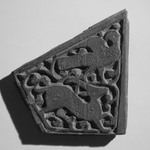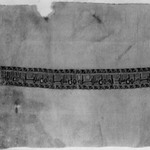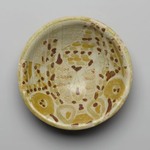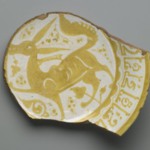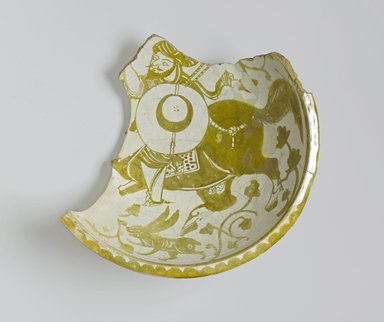
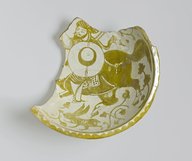
Fragment of a Bowl Depicting a Mounted Warrior, 11th century. Ceramic; earthenware, painted in luster on an opaque white glaze, 15 1/2 x 15 1/2in. (39.4 x 39.4cm). Brooklyn Museum, Gift of the Ernest Erickson Foundation, Inc., 86.227.83. Creative Commons-BY (Photo: Brooklyn Museum, 86.227.83_top_PS1.jpg)
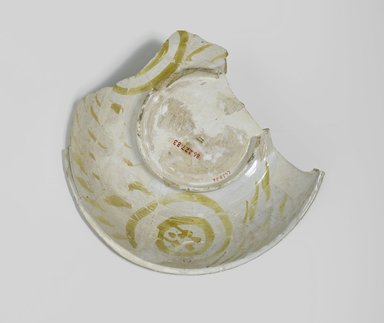
Fragment of a Bowl Depicting a Mounted Warrior, 11th century. Ceramic; earthenware, painted in luster on an opaque white glaze, 15 1/2 x 15 1/2in. (39.4 x 39.4cm). Brooklyn Museum, Gift of the Ernest Erickson Foundation, Inc., 86.227.83. Creative Commons-BY (Photo: Brooklyn Museum, 86.227.83_bottom_PS1.jpg)
Fragment of a Bowl Depicting a Mounted Warrior
Arts of the Islamic World
This fragment of a bowl, depicting a rider carrying a shield (and possibly a lance) atop a galloping horse, is decorated in the luster technique, in which a metallic oxide glaze is applied to the body before firing, leaving a shimmering surface reminiscent of precious metals. Although this object was produced in Egypt during the period of the Fatimid dynasty (909–1171), luster was first developed as a decorative technique for ceramics in Iraq in the ninth century. The technology was also used in Syria and Iran between the eleventh and fifteenth centuries, and was revived in Iran in the late seventeenth or early eighteenth century. Surviving Fatimid Egyptian examples of lusterware were likely excavated at the site of Fustat (Old Cairo) in the early part of the twentieth century. These often display high-quality draftsmanship in the rendition of both humans and animals, quite similar to architectural and manuscript painting of the period.
MEDIUM
Ceramic; earthenware, painted in luster on an opaque white glaze
DATES
11th century
DYNASTY
Fatimid
PERIOD
Fatimid Period
DIMENSIONS
15 1/2 x 15 1/2in. (39.4 x 39.4cm)
(show scale)

INSCRIPTIONS
Label on base reads "Abemayor #408"
COLLECTIONS
Arts of the Islamic World
ACCESSION NUMBER
86.227.83
CREDIT LINE
Gift of the Ernest Erickson Foundation, Inc.
CATALOGUE DESCRIPTION
Pink earthenware body, monochrome lusterware
Found in Fustat (old Cairo). Buff clay, white slip ground covered with clear glaze. Overglaze decoration in olive luster. Bearded cavalier with turban and large shield, adorned with a crescent in left hand. A rabbit trots alongside the horse and rider through palmette vines. The rider's foreshortened foot, his intense sideward gaze, and the scarf or turban end trailing out behind him all illustrate the earthly vitality of this piece. Scenes of hunting, fighting, dancing, and musicians were very popular in the Muslim world from Umayyad times onward, especially for royal patrons or wealthier classes who acquired these wares.
EXHIBITIONS
MUSEUM LOCATION
This item is not on view
CAPTION
Fragment of a Bowl Depicting a Mounted Warrior, 11th century. Ceramic; earthenware, painted in luster on an opaque white glaze, 15 1/2 x 15 1/2in. (39.4 x 39.4cm). Brooklyn Museum, Gift of the Ernest Erickson Foundation, Inc., 86.227.83. Creative Commons-BY (Photo: Brooklyn Museum, 86.227.83_top_PS1.jpg)
IMAGE
top, 86.227.83_top_PS1.jpg. Brooklyn Museum photograph, 2007
"CUR" at the beginning of an image file name means that the image was created by a curatorial staff member. These study images may be digital point-and-shoot photographs, when we don\'t yet have high-quality studio photography, or they may be scans of older negatives, slides, or photographic prints, providing historical documentation of the object.
RIGHTS STATEMENT
Creative Commons-BY
You may download and use Brooklyn Museum images of this three-dimensional work in accordance with a Creative Commons license. Fair use, as understood under the United States Copyright Act, may also apply.
Please include caption information from this page and credit the Brooklyn Museum. If you need a high resolution file, please fill out our online application form (charges apply).
For further information about copyright, we recommend resources at the United States Library of Congress, Cornell University, Copyright and Cultural Institutions: Guidelines for U.S. Libraries, Archives, and Museums, and Copyright Watch.
For more information about the Museum's rights project, including how rights types are assigned, please see our blog posts on copyright.
If you have any information regarding this work and rights to it, please contact copyright@brooklynmuseum.org.
RECORD COMPLETENESS
Not every record you will find here is complete. More information is available for some works than for others, and some entries have been updated more recently. Records are frequently reviewed and revised, and we welcome any additional information you might have.