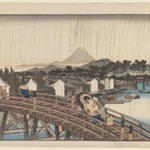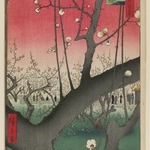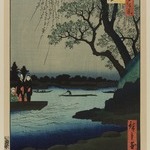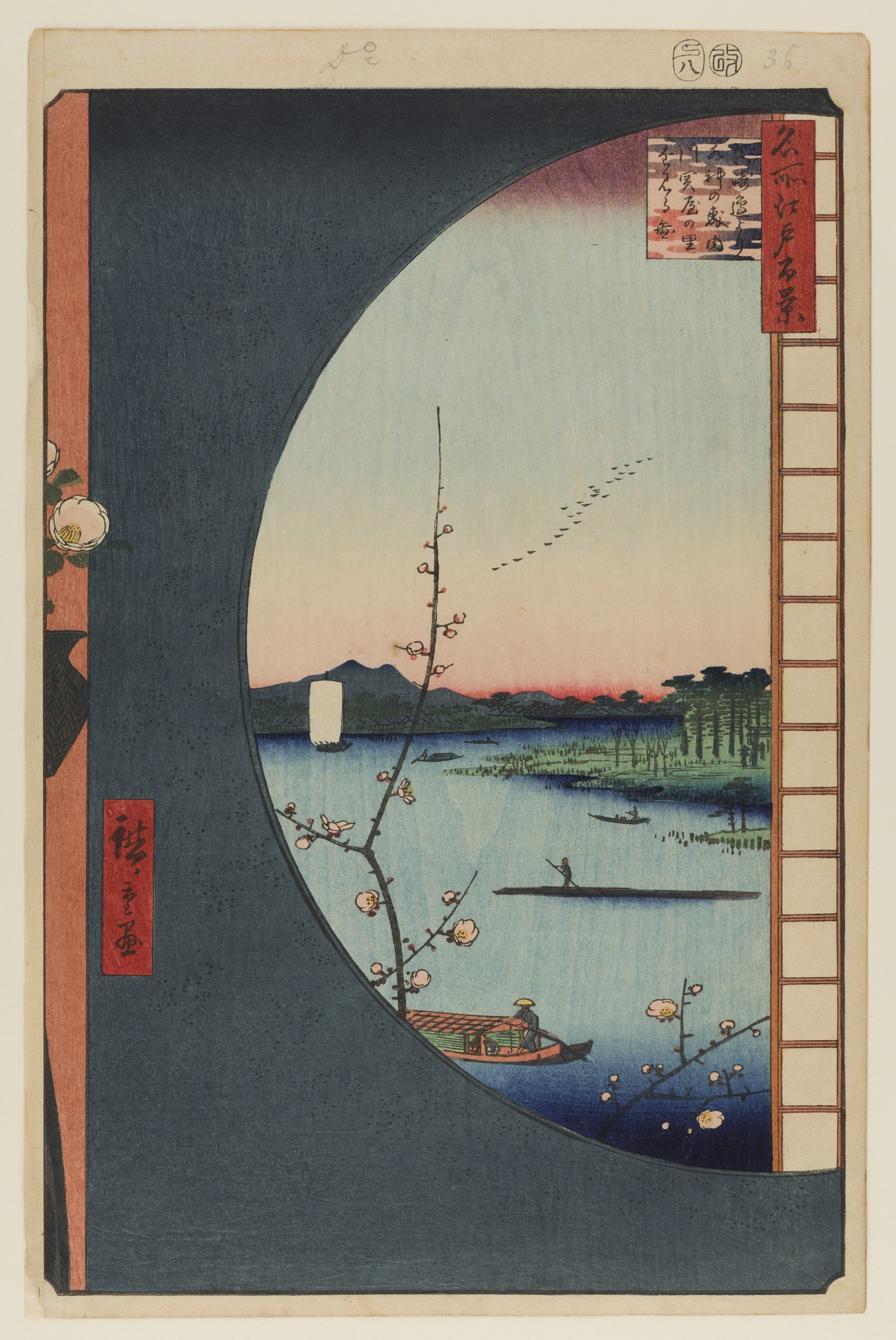
View From Massaki of Suijin Shrine, Uchigawa Inlet, and Sekiya, No. 36 in One Hundred Famous Views of Edo
Utagawa Hiroshige
Asian Art
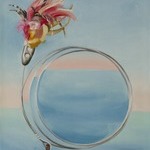
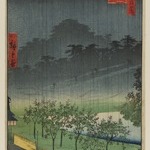
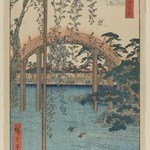
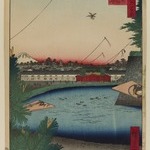
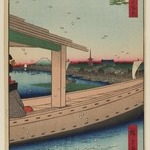
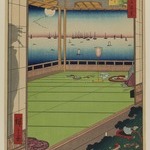
Late in an early spring day, we sit on the second floor of one of the teahouses in front of Massaki Inari Shrine, savoring the dengaku—small squares of skewered tofu brushed with a sweet miso sauce and grilled over charcoal—that was the famed signature dish of these restaurants. We have here reversed directions from the previous print and are now on the west side of the Sumida River looking northeast.
Suijin Shrine is just visible in the grove of trees to the right. In the distance we see the Uchigawa Inlet, the Sekiya plains, and the twin peaks of Mount Tsukuba.
MEDIUM
Woodblock print
DATES
8th month of 1857
PERIOD
Edo Period, Ansei Era
DIMENSIONS
14 1/4 x 9 1/4 in. (36.2 x 23.5 cm) (show scale)

MARKINGS
Signature in red cartouche, lower left. Date and censor seals, upper right. No publisher's seal visible, probably lost when left margin was trimmed.
SIGNATURE
Hiroshige-ga
COLLECTIONS
Asian Art
ACCESSION NUMBER
30.1478.36
CREDIT LINE
Gift of Anna Ferris
PROVENANCE
Prior to 1930, provenance not yet documented; by 1930, acquired by Anna Ferris of Summit, NJ; 1930, gift of Anna Ferris to the Brooklyn Museum.
Provenance FAQ
CATALOGUE DESCRIPTION
This scene in early spring looks out from the round window on the Sumida River from the second floor of a teahouse in front of the Massaki Inari Shrine. This restaurant may well be the "Kinoeneya," most famous for its "dengaku," small squares of skewered tofu, brushed with a sweet miso sauce and grilled over charcoal. The Uchigawa Inlet extends in the distance to the right. The area on the far side, below Mount Tsukuba, is the Sekiya no Sato, a name given for the countryside here. The popularity of Massaki Inari and that of the "dengaku" restaurants, within this area, began in 1757 and was still strong in Hiroshige's time.
EXHIBITIONS
MUSEUM LOCATION
This item is not on view
CAPTION
Utagawa Hiroshige (Japanese, 1797–1858). View From Massaki of Suijin Shrine, Uchigawa Inlet, and Sekiya, No. 36 in One Hundred Famous Views of Edo, 8th month of 1857. Woodblock print, 14 1/4 x 9 1/4 in. (36.2 x 23.5 cm). Brooklyn Museum, Gift of Anna Ferris, 30.1478.36 (Photo: Brooklyn Museum, 30.1478.36_PS20.jpg)
IMAGE
overall, 30.1478.36_PS20.jpg. Brooklyn Museum photograph, 2023
"CUR" at the beginning of an image file name means that the image was created by a curatorial staff member. These study images may be digital point-and-shoot photographs, when we don\'t yet have high-quality studio photography, or they may be scans of older negatives, slides, or photographic prints, providing historical documentation of the object.
RIGHTS STATEMENT
No known copyright restrictions
This work may be in the public domain in the United States. Works created by United States and non-United States nationals published prior to 1923 are in the public domain, subject to the terms of any applicable treaty or agreement.
You may download and use Brooklyn Museum images of this work. Please include caption information from this page and credit the Brooklyn Museum. If you need a high resolution file, please fill out our online application form (charges apply).
The Museum does not warrant that the use of this work will not infringe on the rights of third parties, such as artists or artists' heirs holding the rights to the work. It is your responsibility to determine and satisfy copyright or other use restrictions before copying, transmitting, or making other use of protected items beyond that allowed by "fair use," as such term is understood under the United States Copyright Act.
The Brooklyn Museum makes no representations or warranties with respect to the application or terms of any international agreement governing copyright protection in the United States for works created by foreign nationals.
For further information about copyright, we recommend resources at the United States Library of Congress, Cornell University, Copyright and Cultural Institutions: Guidelines for U.S. Libraries, Archives, and Museums, and Copyright Watch.
For more information about the Museum's rights project, including how rights types are assigned, please see our blog posts on copyright.
If you have any information regarding this work and rights to it, please contact copyright@brooklynmuseum.org.
RECORD COMPLETENESS
Not every record you will find here is complete. More information is available for some works than for others, and some entries have been updated more recently. Records are frequently reviewed and revised, and we welcome any additional information you might have.