Soul in Bondage

Brooklyn Museum photograph
Object Label
In this brooding Symbolist subject titled Soul in Bondage, the American expatriate Elihu Vedder brought together his key interests in idealized human form, abstracted design, and the themes of internal spiritual conflict. Profoundly inspired by the writer Edward Fitzgerald's translation of mystical Persian verse in the Rubáiyát of Omar Khayyám (Vedder illustrated a lush 1884 edition), he created numerous subjects representing the individual bound by the dilemma of choice between good and evil symbolized here by the butterfly and the serpent. Behind the figure Vedder employed his signature "double swirl," a motif he had used repeatedly in the Rubáiyát illustrations to suggest the forces that converge and then disperse around the brief point that constitutes an individual human life.
Caption
Elihu Vedder (American, 1836–1923). Soul in Bondage, 1891–1892. Oil on canvas, 37 13/16 x 24 in. (96.1 x 60.9 cm) frame: 53 1/8 x 39 1/8 x 3 3/8 in. (134.9 x 99.4 x 8.6 cm). Brooklyn Museum, Gift of Mrs. Harold G. Henderson, 47.74. (Photo: Brooklyn Museum)
Gallery
Not on view
Collection
Gallery
Not on view
Collection
Artist
Title
Soul in Bondage
Date
1891–1892
Medium
Oil on canvas
Classification
Dimensions
37 13/16 x 24 in. (96.1 x 60.9 cm) frame: 53 1/8 x 39 1/8 x 3 3/8 in. (134.9 x 99.4 x 8.6 cm)
Signatures
Signed lower right: "ELIHU VEDDER/ ROMA/ 1891"; signed lower left: (inititial in monogram): "V"
Credit Line
Gift of Mrs. Harold G. Henderson
Accession Number
47.74
Frequent Art Questions
Tell me more.
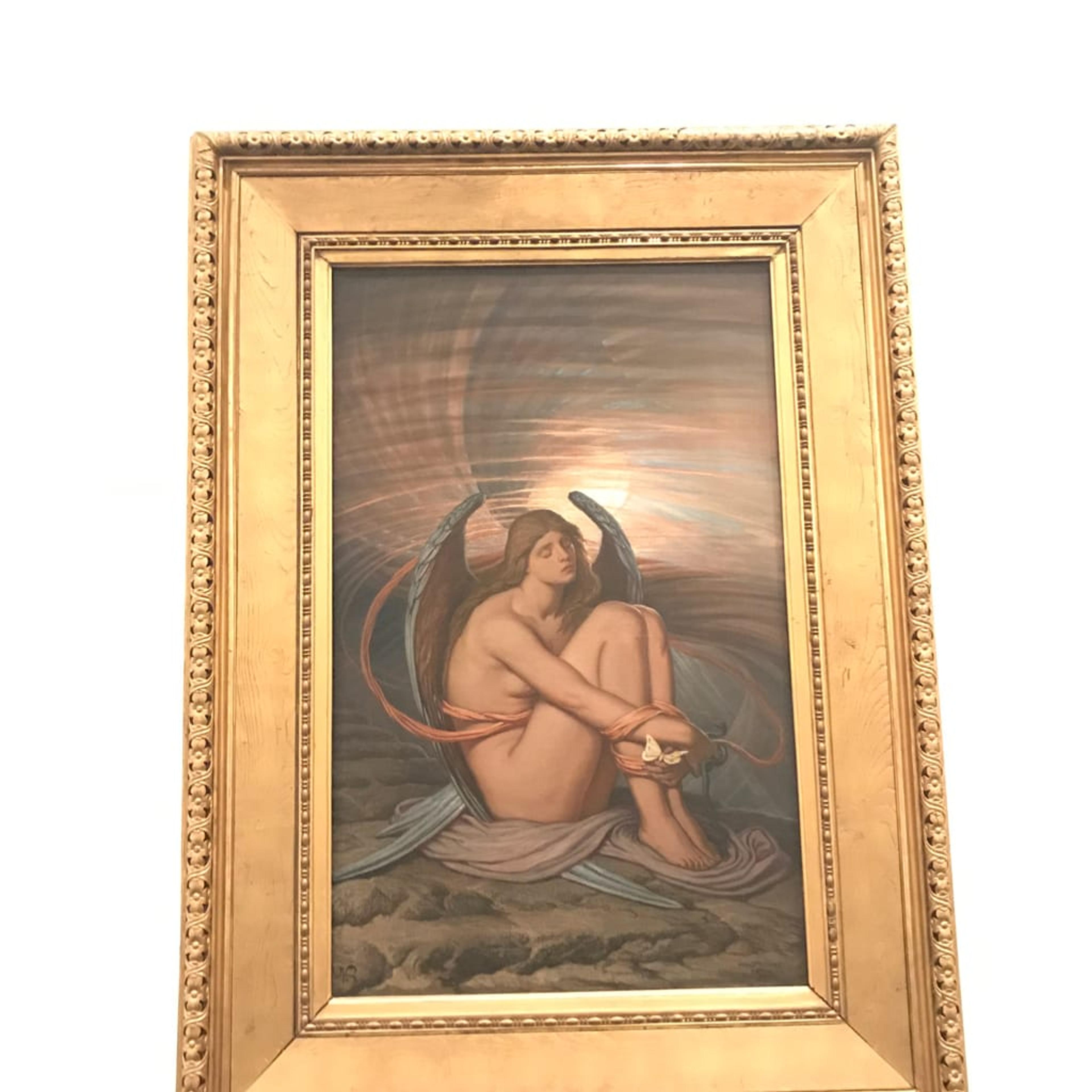 This work is an example of Symbolist painting. Symbolist artists like Elihu Vedder believed art should reflect an emotion or idea rather than merely represent the natural world.This individual represents spiritual conflict. Good is symbolized by the yellow butterfly and evil by the blue serpent.Fun app, thanks!I'm glad you're enjoying it!
Have information?
Have information about an artwork? Contact us at