Oyster Plate


1 of 5
Caption
Thomas C. Smith (American, 1815–1901). Oyster Plate, patented January 4, 1881. Porcelain with enamel and gilding, 3/4 x 8 5/8 x 6 5/8 in. (1.9 x 21.9 x 16.8 cm). Brooklyn Museum, H. Randolph Lever Fund, 66.182. (Photo: Brooklyn Museum)
Collection
Collection
Designer
Manufacturer
Title
Oyster Plate
Date
patented January 4, 1881
Geography
Place manufactured: Brooklyn, New York, United States
Medium
Porcelain with enamel and gilding
Classification
Dimensions
3/4 x 8 5/8 x 6 5/8 in. (1.9 x 21.9 x 16.8 cm)
Signatures
no signature
Inscriptions
no inscriptions
Markings
On underside: printed in yellow within urn, "UNION / PORCELAIN / WORKS / GREENPOINT / N.Y."; printed in green, "PAT. JAN. 4. 1881 / U.P.W. / [head of an eagle]"
Credit Line
H. Randolph Lever Fund
Accession Number
66.182
Frequent Art Questions
What can you tell me about this plate?
That's an Oyster Plate from the late 19th century. Made in Greenpoint New York. It features a beautiful polychrome decorations and intricate sculpting.Is there an artist name?It was manufactured by Union Porcelain Works. Which was the foremost porcelain maker in American from 1862 to 1922 and is actually credited with manufacturing the first American oyster plates. Many artists likely worked to create this piece from mould makers, glaze artists and craftsmen specializing in operating kilns. The Union Porcelain Works employed up to 200 people around the time this oyster plate was created.Was this used for Oysters?
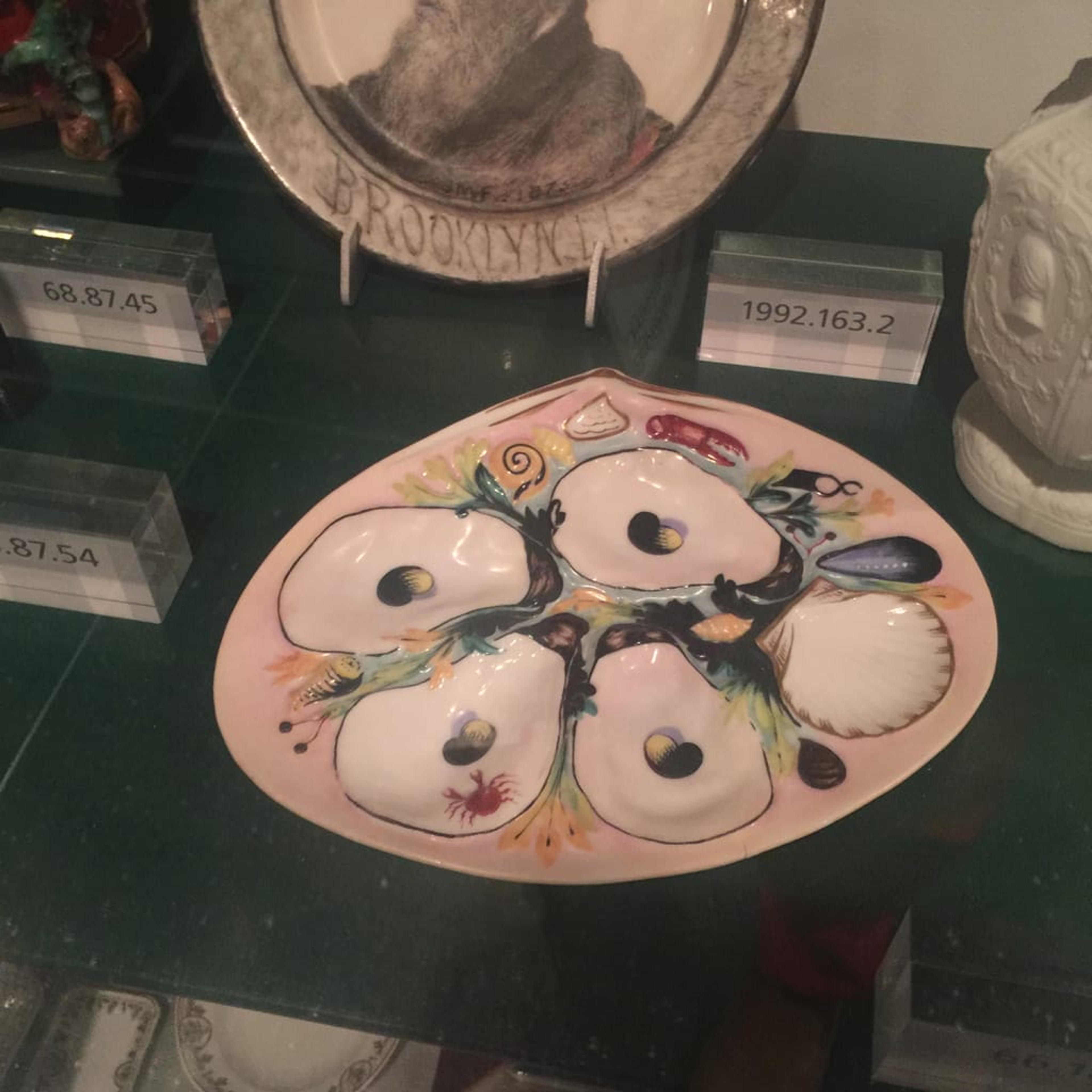 Yes! This is an oyster plate made here in Brooklyn at the Union Porcelain Works in 1881.Oysters were enormously popular in 19th century-NYC. They were like pizza today, sold on every corner! They were also popular with the theatre-going crowd. In a way, before we were The Big Apple, NYC was The Big Oyster!
Have information?
Have information about an artwork? Contact us at