Inscribed Headrest


1 of 2
Object Label
The standard Egyptian headrest—the equivalent of the modern pillow—consisted of a curved neck support atop a pillar on an oblong base. When a head rested on a support, the combination of round and curved forms resembled the morning sun rising between two peaks, which is also the hieroglyph for “horizon.” Thus the sleeper was connected to the sunrise, a potent symbol of resurrection. Some modern Africans, particularly in Mali and Kenya, still sleep on headrests identical in design to ancient Egyptian examples.
Caption
Inscribed Headrest, ca. 1818–1700 B.C.E.. Wood, 9 x 9 3/8 x 4 7/16 in. (22.8 x 23.8 x 11.2 cm). Brooklyn Museum, Gift of the Egypt Exploration Fund, 14.650. (Photo: Brooklyn Museum)
Title
Inscribed Headrest
Date
ca. 1818–1700 B.C.E.
Dynasty
late Dynasty 12 to early Dynasty 13
Period
Middle Kingdom
Geography
Place excavated: Soknopaiou Nesos (Dimai), Egypt
Medium
Wood
Classification
Dimensions
9 x 9 3/8 x 4 7/16 in. (22.8 x 23.8 x 11.2 cm)
Inscriptions
ḫtmw-bjtj; smr-wꜥtj; ẖrj-ḥb; jmj-rꜣ smw; jmj-rꜣ smjjt ḫt
Credit Line
Gift of the Egypt Exploration Fund
Accession Number
14.650
Frequent Art Questions
I always find it funny that these were used as pillows. When did soft pillows become standard?
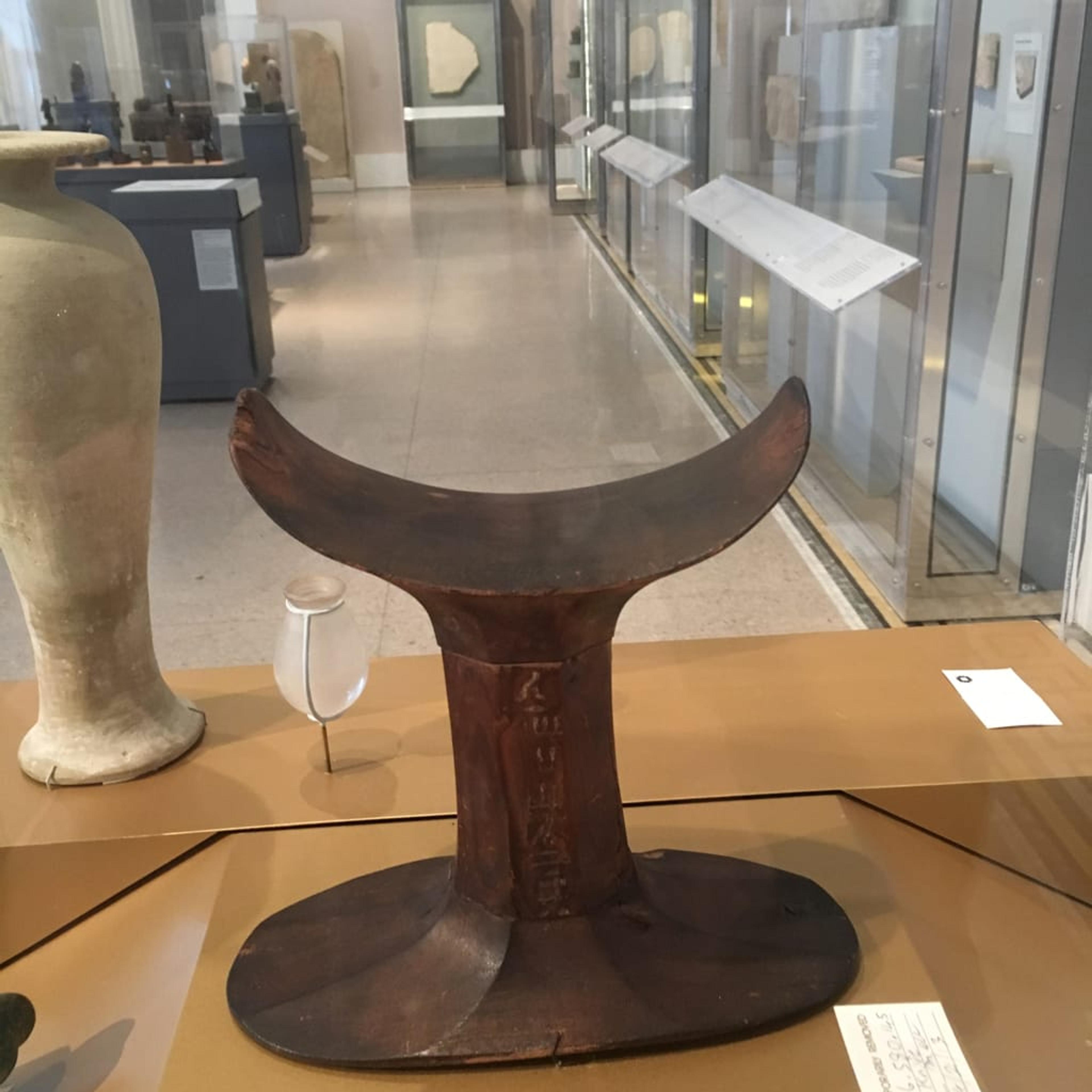 These headrests would have had some kind of cushioning on the wood that has not survived, so this type of pillow is not as far off from a "modern" pillow as you might think. They're not as uncomfortable as they look!
Have information?
Have information about an artwork? Contact us at