Skip main navigation
The Brooklyn Museum

Collections: Egyptian, Classical, Ancient Near Eastern Art


Showing objects 1 - 48 of 1,249Next

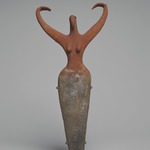
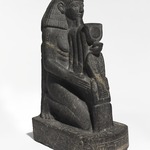
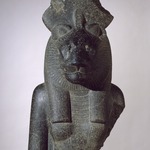
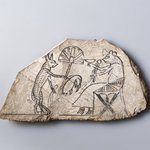
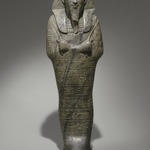
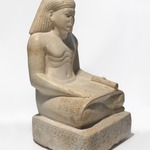
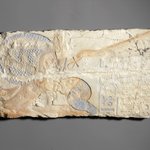
Bowl with Lug HandlesRelief of Men TalkingFragment of PaletteGlass InlayMirror with Handle in the Form of WomanMummified IbisSeated Statuette of Pepy I with Horus FalconKnife BladeBeaded NecklaceHoop EarringPaddle DollImage of a Ba-bird on a Footpiece from a CoffinSoldiers in ChariotRelief of Sandaled Feet of a Royal WomanAmulet in the Form of a Ba as Human-Headed BirdColossal Left FootShabty of Nesi-ta-nebet-Isheru, Daughter of Pinedjem IISeated Statue of NakhtsaesBlock Statue of Senwosret-senebefnyRelief of a KingPair Statue of Nebsen and Nebet-taStatuette of a MonkeyStatuette of Pregnant Female Carrying ChildFemale Ancestral BustPair of Earrings in Form of Pendant Lotus FlowersStela of Senres and HormoseRelief of AntelopesBracteateLady TjepuHead from a Composite StatueShabty of Queen HenuttawyStela of User-pekhty-nisu and his wife, Pa-netjerOffering Stand of Irukaptah with BowlCoffin and Cover of Princess MayetUshabti of PsamtekStanding Statuette of a King in a Blue Crown (Probably Akhenaten)Right Hand from an Anthropoid CoffinRectangular Toilet Spoon with HandleTriad of Isis, the Child Horus, and NephthysSunk Relief of Queen NeferuDoorjamb of ThaasetimuShabty of MuthotepBlack-Topped Pottery JarRelief with Deities and High PriestessFunerary Figurine of AkhenatenSwamp ScenePinRelief with Netherworld Deities

Showing objects 1 - 48 of 1,249Next


Recent Blog Posts

More brick A view south from the precinct’s north enclosure wall of the whole area where we are now working. At the left are Chapel D and the Taharqa Gate; in the read more...

close

More brick

Richard Fazzini on February 5, 2010
Gen_Wed.jpg

A view south from the precinct’s north enclosure wall of the whole area where we are now working. At the left are Chapel D and the Taharqa Gate; in the center the paving of the approach to the gate; and in the upper right the two squares we have opened on the high ground west of the gate.

Bill.jpg   elsie.jpg

Before I get to the work, I want to welcome back William and Elsie Peck, who arrived this week. Bill has been with the Mut Expedition longer than anyone except me, while Elsie joined us in 1979, which was also Mary’s first year. Bill’s first job this season is to map the new paving west of the Taharqa Gate. Elsie once again has taken on keeping the digging records, beginning with what Mahmoud Abbadi is doing in the corridor south of the Taharqa Gate.

W2S_to_S.jpg   W2S_to_N.jpg

The corridor at the end of the week, looking south (left) and north. The limestone chip layer at the north end now extends almost the full length of the corridor and is mixed with pieces of sandstone and pottery. What we had thought might be two brick walls on the west side of the corridor (on the right in the left picture) turned out to be a single wall whose northern end had been robbed out. Behind the meter stick in the left picture is a more organized grouping of stone fragments that seems to be an intentional blocking of the corridor at the south end of this wall.

photog_aloft.jpg

Mary photographing the corridor in the early morning. Photographing from the top of a ladder is not her favorite activity, but sometimes it is necessary. I thank Jaap for this picture.

W3_TG_wall.jpg

We expanded the square north of the Taharqa Gate and now have the full width of the gate wall from the first room of Chapel D (left) to the wall’s west face.

W3_bb1.jpg

On the east side of the expanded enclosure wall square we found this curious baked brick feature set into the east side of the wall. Of the south and north walls only a few bricks remain, so we will never know what it was. Its presence, though, suggests there may have been a corridor (or at least a space) between the rear rooms of Chapel D and the Taharqa Gate wall.

W4_Thur.jpg

The square on the high ground west of the gate, where Abdel Aziz found a mud brick wall last week, has produced no architectural remains since then, which doesn’t surprise us. The area is part of the same mass of debris we found last season, filling the space between the north and south boundary walls of the approach to the Taharqa Gate to a depth of almost 3 meters. We hope that the debris isn’t that deep in this square, which abuts an area of Ptolemaic and early Roman Period habitations.

W5_start.jpg

On Saturday we opened a new square just south of Abdel Aziz to try to find more of the mud brick buildings discovered last year. You can see some of them in the upper right corner of this photograph. Abdullah struck mud brick almost immediately, only about 10 cm below the modern surface.

W5_Thur2.jpg

The same area at the end of work on Thursday, looking east. We already have at least 2 phases of brick walls (foreground), an area of confused brick in the southeast corner (under the meter stick) and in the northeast corner a patch that so far is just loose earth. Have I mentioned that mud brick is complicated?

mould.jpg

Our most interesting find of the week was this mould for a figure of Osiris. Even though the figure is only about 2 inches tall, it is very finely carved with a great deal of detail. The only problem is that it did not turn up in the areas we are excavating: I found it on the ground behind a gate in the Mut Temple’s first pylon one day this week while checking inscriptions.

wall.jpg   park.jpg

In 2007, local artists created a mosaic-decorated wall along the road to Karnak in front of a rundown cemetery for foreigners who died in Luxor; here it is in progress. During last year the city government decided to move the residents to a new cemetery and create a lovely public park on the grounds (right).

park_mushroom.jpg

Among the park’s most charming features are groups of whimsical sculptures, my favorite being this cluster of mushrooms.

go to the original blog post...

close

The Week of the Brick Tracing mud brick takes skill, patience and lots of scraping and brushing. It is paying off for Ayman and his team, though. By Tuesday, they had already uncovered quite a read more...

close

The Week of the Brick

Mary McKercher on January 29, 2010
brush_brick.jpg

Tracing mud brick takes skill, patience and lots of scraping and brushing. It is paying off for Ayman and his team, though. By Tuesday, they had already uncovered quite a bit of brick in the center of the square north of the Taharqa Gate. This is surely the enclosure wall into which the Taharqa Gate was set, but we can’t yet connect it to the gate directly.

W3_Wed.jpg

The lighter area in the center of the photo is the brick as it was on Wednesday. The row of 5 bricks visible here against the center of Chapel D confirms that this chapel was built against the east face of the Taharqa Gate enclosure wall as we’d always assumed. There is more brick in the gap to the north but at a lower level.

shade.jpg

Even when you can see bricks clearly, the faint color differences between brick, mortar and surrounding earth can make them hard to photograph, particularly in strong sunlight. A large bedsheet makes a good shade cloth, providing even, subdued light where needed.

TG_bricks_S.jpg

And here’s what’s in the shade. By Thursday at noon, Ayman had found brick in the corner where the Taharqa Gate (right) and Chapel D meet, although at a lower level than the brick in the center of the square. This is definitely the Taharqa Gate enclosure wall, beautifully built of large bricks laid in even rows.

AA_brick.jpg   W4_brick.jpg

After slogging through more than 50 cm of loose earth, Abdel Aziz, too, found brick on the south side of his square on the rise west of the Taharqa Gate. Here the problem was the dryness of the soil, which makes the brick extremely friable. Despite the distinctive white mortar this brick was a bit tricky to define as it was almost as dry (and soft) as the earth around it.

TG_S_brick.jpg

South of the Taharqa Gate, in a probable corridor between the Taharqa Gate wall and the wall to its west, we have come on a narrow diagonal brick wall running almost 4 meters along the space, its purpose unknown. It sits on a layer of earth with lots of limestone chips and at its south end the brick is extended by a rough row of small pieces of limestone (to the left of the meter stick).

W2S.jpg

The same area at the end of the week. Below the limestone blocks was another row of brick (under the meter stick) built against the corridor’s west wall. Just visible to its north and at a lower level is another patch of brick that was built on the same layer of limestone chips as the diagonal wall to the north.

khaled.jpg

Conservator Khaled Mohamed Wassel is back with us for another season. He has spent most of the past week reconstructing some thoroughly broken pottery, a task he is doing with patience and good will. We hope to have more interesting work for him in the coming weeks.

betsy.jpg

Another treat this week was seeing Dr. Betsy Bryan, director of the Johns Hopkins University excavation, who is out for a short time this winter. She, Richard and Jaap catch up on news about work at the site.

goats.jpg

And here are our most regular visitors, who stop by every day to see what is going on. I suspect, however, that they are more interested in the camel thorn and reeds than in the temples.

kestrel.jpg   black_winged_stilt.jpg

To end the week, here are two more terrific bird photographs from Jaap. On the left, a female kestrel soars overhead. On the right, a family of black-winged stilts that lives on the shore of the sacred lake. The two in the center are juveniles, the other two adults.

go to the original blog post...

close

We’re up and running    On Sunday, Abdel Aziz began looking for more of the mud brick found last week. He had no luck, as the northern part had been completely destroyed by the read more...

close

We’re up and running

Richard Fazzini on January 22, 2010
AA_find1.jpg   AA_take2.jpg

On Sunday, Abdel Aziz began looking for more of the mud brick found last week. He had no luck, as the northern part had been completely destroyed by the Roman pit and extensive animal burrow we found in 2008. In the pit, however, Abdel Aziz did turn up a large piece of what would once have been a very nice diorite statue; he was quite proud of his find.

bowl1.jpg   bowl2.jpg

Here it is a few days later, somewhat cleaned up. When complete, it depicted a kneeling man holding an offering bowl bigger than he was. The text around the bowl would have named him and included an offering formula to a god (or goddess). Unfortunately all we have left is the tail end of the inscription. Even though his face is gone, the high quality of the carving of the wig, kilt and hieroglyphs is evident.

bowl3.jpg   24ME2.jpg

The right side of the “bowl man”; on the right a cowrie shell (about 2 cm long) whose back has been carefully sawn off to make it lie flat. It immediately put me in mind of the symbolism in Judy Chicago’s The Dinner Party. According to our inspector, Hassan, cowrie shells are still used by fortune-tellers who throw shells on the ground and read the future in the patterns they form.

E_brick1.jpg

Here is the area north of Mut’s 1st Pylon at the end of the week. Our goal was to make as much sense of the brick as we could, which we have done, although the purpose of the foundations is not yet clear.

Jaap.jpg

On the 18th we were happy to welcome Jacobus van Dijk back for another season. Jaap has an eagle eye for inscriptions, even climbing on top of awkward sphinx bases to have a good look.

Ayman.jpg  W3a.jpg

Qufti Ayman Farouk Sharid is now working north of the Taharqa Gate trying to trace the wall that ran north from the gate, of which only a stub remains visible. We also want to figure out how that wall relates to the northern boundary wall of the approach to the gate. So far no answers to those questions, but Ayman has turned up yet another stub of wall, behind the meter stick, that is made up of unusually large bricks.

W2C_paving.jpg   Abdullah1.jpg

Mahmoud finished clearing the SW corner of the approach to the gate this week, revealing more paving running into the west baulk (left). To our surprise, he also found fragmentary remains of a mud brick structure (under the meter stick) built on the same level as the paving. Is it contemporary with the Taharqa Gate? We may never know as the rest of it lies under the later southern boundary wall of the the gate’s approach. Meanwhile, Abdullah Mousa, in the green galabiya, is now working in the NW corner of this square (right), taking down the strata of debris and walls left at the end of last season.

W_gen.jpg

For the rest of the season we will be concentrating our efforts on the Taharqa Gate and the area to its west and south. Here you are looking south at the whole area at the end of work on Thursday. We have opened a new square on the high ground west of the gate (right), where Abdel Aziz will be working now that he’s finished with the brick in front of Mut’s 1st pylon.

Kite1.jpg   Kite2.jpg

Our first bird photos of the season. On Thursday Jaap caught this black kite soaring over the precinct (left) then swooping down on some unlucky creature who was about to become lunch. We’re glad you’re back, Jaap.

go to the original blog post...

close

read all Egyptian, Classical, Ancient Near Eastern Art blog posts

Join the posse or log in to work with our collection. Your tags, comments, and favorites will display with your attribution.

Recent Comments

"this is shown in the chrysler museum"
by Holly

"i feel bad for the people who had to work so much"
by desiree

"this is so awsome "
by desiree

Recently Favorited

Female Figure was favorited
by Rene

Relief of Mourning Women was favorited
by gcelestin

Head and Torso of a Noblewoman was favorited
by Soninka

Recently Tagged Objects

Tile with Winged, Crowned Sphinx was tagged "lion"
by Haha

Tile with Winged, Crowned Sphinx was tagged "crown"
by Haha

Tile with Winged, Crowned Sphinx was tagged "head"
by Haha


more
Highlights
all

Resources & Related Links

Tags in Egyptian, Classical, Ancient Near Eastern Artall
Culturesall
Exhibitionsall