Alexander the Great
100 B.C.E. – 100 C.E.


1 of 7
Object Label
Alexander conquered Egypt in 332 B.C.E. He fostered a connection between Greek and indigenous Egyptian cultures. His successors promoted Egyptian religion, including the making of animal mummies.
This posthumous statue was carved from an Egyptian stone in the Greek style that emphasizes motion by the twist of the head and neck.
This posthumous statue was carved from an Egyptian stone in the Greek style that emphasizes motion by the twist of the head and neck.
Caption
Alexander the Great, 100 B.C.E. – 100 C.E.. Marble, 3 1/2 × 2 × 1 1/2 in. (8.9 × 5.1 × 3.8 cm) mount: 7 × 2 1/4 × 1 3/4 in. (17.8 × 5.7 × 4.4 cm). Brooklyn Museum, Charles Edwin Wilbour Fund, 54.162. (Photo: Brooklyn Museum (Gavin Ashworth, photographer))
Gallery
Not on view
Gallery
Not on view
Title
Alexander the Great
Date
100 B.C.E. – 100 C.E.
Period
Late Period to Roman Period
Geography
Reportedly from: Egypt
Medium
Marble
Classification
Dimensions
3 1/2 × 2 × 1 1/2 in. (8.9 × 5.1 × 3.8 cm) mount: 7 × 2 1/4 × 1 3/4 in. (17.8 × 5.7 × 4.4 cm)
Credit Line
Charles Edwin Wilbour Fund
Accession Number
54.162
Frequent Art Questions
Who is the person in the middle?
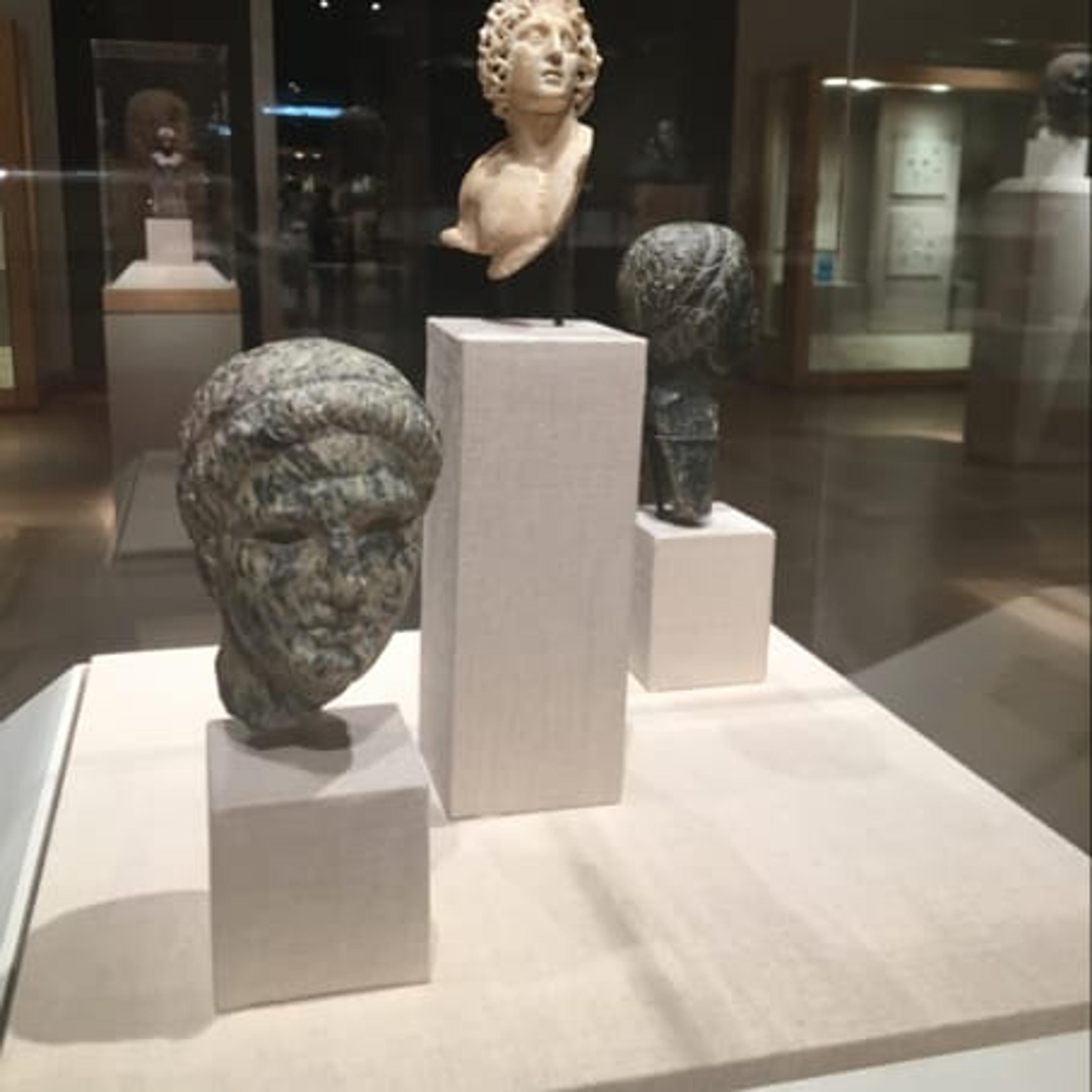 That's Alexander! Alexander the Great was the king of Macedonia, and a very successful general. He was so, well, great, that by the age of 24 he managed to conquer most of the known world! Starting from the Greek homeland, he conquered Egypt, Persia, Babylon and made it all the way to India, all in just a few years. He united the known world in a single empire, and people were crazy about him in the way today we like pop stars. Images of Alexander, like this figurine showing him at about 20 years old, twisting his body, caught mid-action, his hair flying everywhere, are markedly different from earlier Greek art, which is much more restrained.
Have information?
Have information about an artwork? Contact us at