Jade Cup with Chinese Inscription
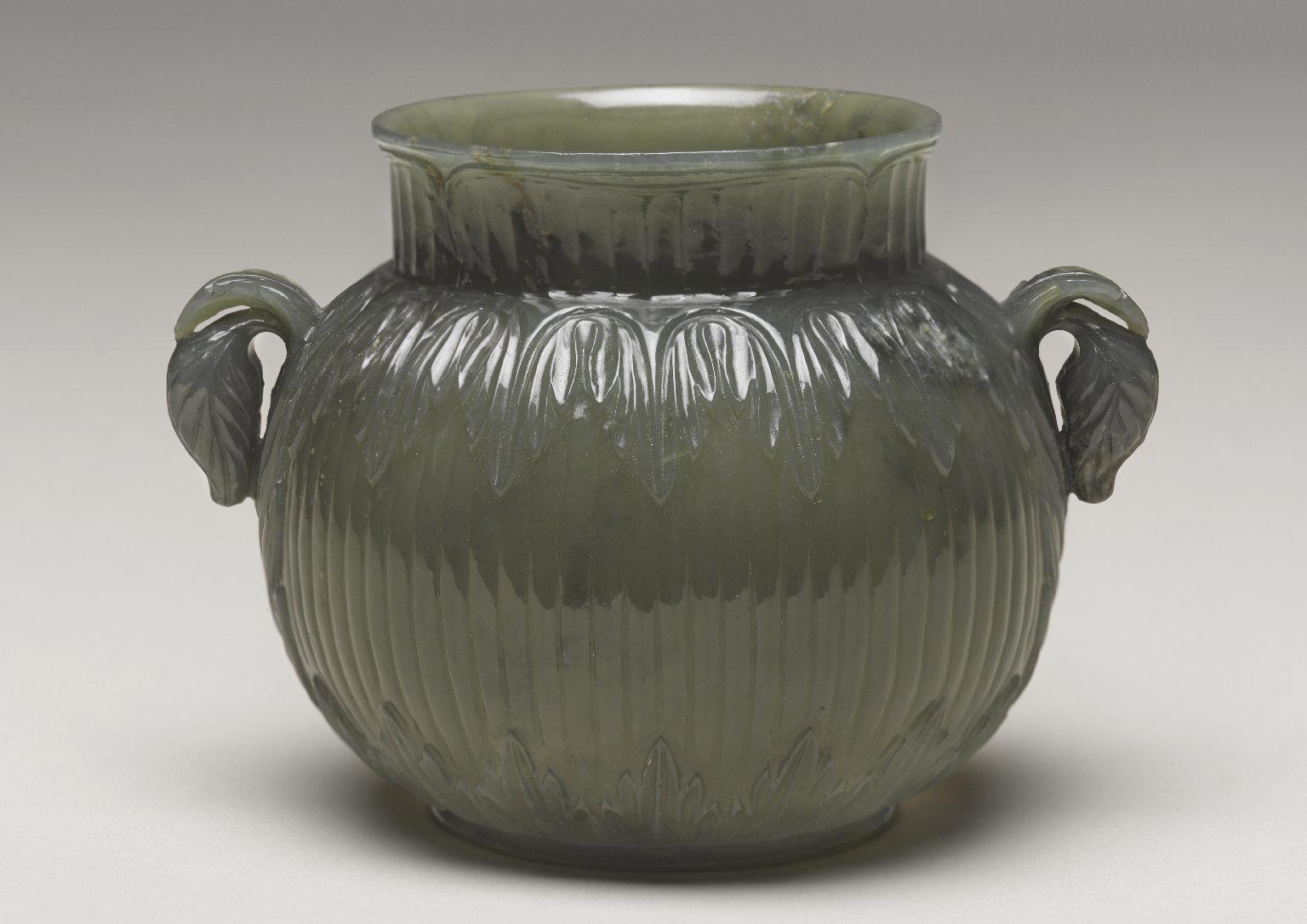
Brooklyn Museum photograph
Object Label
Gift exchange, tribute, the spread of religion, and overland as well as maritime trade were major transmitters of motifs, designs, and techniques between China and the Roman Empire, Iran, and India. Primary goods, such as medicinal herbs, spices, animals (especially horses), animal products, ores, and metals traveled east to China, while silk products, ceramics, metal wares, paper, printed texts, and mint coins traveled west.The Chinese Qianlong reign mark inscribed on the base of this carved jade cup produced in Mughal India testifies to the great distances some objects traveled over space and time and how they belonged to different owners at different times. The cup's shape may have derived from similar objects produced in Iran under the Timurids (1370–1507), while the acanthus motifs on its shoulders and handles recall India’s contact with Europe under the Mughals (1526–1858).
Caption
Unknown Artist Mughal Artist. Jade Cup with Chinese Inscription, mid 17th century. Carved Jade, at base: 3 1/4 x 2 1/8 in. (8.3 x 5.4 cm). Brooklyn Museum, Gift of Mr. and Mrs. Alastair B. Martin, the Guennol Collection, 78.7. (Photo: Brooklyn Museum)
Title
Jade Cup with Chinese Inscription
Date
mid 17th century
Period
Qianlong reign mark
Medium
Carved Jade
Classification
Dimensions
at base: 3 1/4 x 2 1/8 in. (8.3 x 5.4 cm)
Inscriptions
Inscription of 4 characters in center of base, reading "Qianlongnian zhi" (Made in the Qianlong Era)
Markings
Qianlong reign mark (1736-1795) on base
Credit Line
Gift of Mr. and Mrs. Alastair B. Martin, the Guennol Collection
Accession Number
78.7
Have information?
Have information about an artwork? Contact us at