Elephant Tusk Carved with Figures in Relief
Vili


1 of 3
Object Label
The staff has long been a symbol of authority and power in Western culture. Contact between Europe and Africa transplanted both the form and its meaning to Africa during the European Renaissance, and the African staff took on new forms of decoration. By the mid-nineteenth century, African craftsmen were also carving ivory tusks specifically for the export market with horizontal bands of narrative figures spiraling up the form. These were based on African side-blown horns, which had been carved with similar decoration, but in the works for export the function of a horn has been lost in favor of the value to Westerners of the ivory, which was traded along the same routes as slaves.
Caption
Vili. Elephant Tusk Carved with Figures in Relief, late 19th century. Ivory, graphite, 39 x 4 3/8 x 8 x 4 in. (99.1 x 11.1 x 20.3 x 10.2 cm). Brooklyn Museum, A. Augustus Healy Fund, 35.679. (Photo: Brooklyn Museum)
Tags
Gallery
Not on view
Collection
Gallery
Not on view
Collection
Culture
Title
Elephant Tusk Carved with Figures in Relief
Date
late 19th century
Geography
Possible place made: Loango Coast, Cabinda Province, Angola
Medium
Ivory, graphite
Classification
Dimensions
39 x 4 3/8 x 8 x 4 in. (99.1 x 11.1 x 20.3 x 10.2 cm)
Credit Line
A. Augustus Healy Fund
Accession Number
35.679
Frequent Art Questions
Hi! Do you know what they're narrating here?
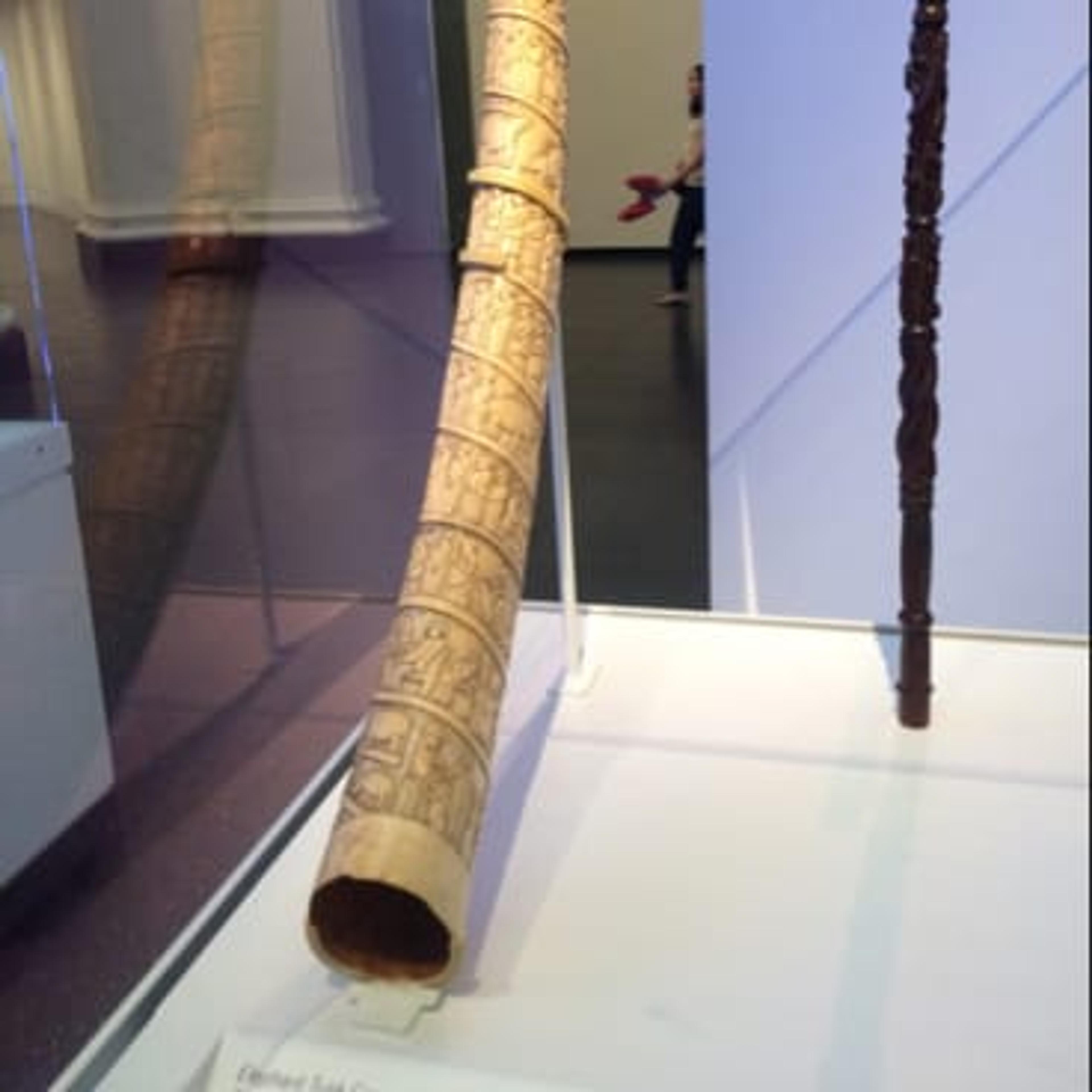 Hi there great question! There are almost 150 figures spiraling around the tusk, but they don't tell a continuous narrative, but rather exemplify aspects of Kongo life through a series of vignettes. Some drink palm wine, others recline in chairs. Although Kongo art is known for its dynamism these figures and their poses are especially expressive and unusually naturalistic. The body positioning and facial expressions are remarkable.The Kongo Artist who carved this great tusk gives us numerous visual references to European influence – the men and women are shown wearing skirts, hats and shirts which were common in the 1880s due to Portuguese colonization. This piece of Ivory didn't serve a specific purpose other than to be traded.Thank you!
Have information?
Have information about an artwork? Contact us at