Looking for love?

I’ve been at the Brooklyn Museum for about a year-and-a-half now, which is also as long as I’ve been a resident of our fair borough. I’ve worked many places in the country—at and for different museums—and one thing that struck me almost as soon as I arrived here is the social nature of Brooklynites, and in particular, our visitors. Our numbers support my first impression: 65% of you come with adult friends or family members. And although 24% of you come alone, at least some singles are seeking a social outlet as we get asked regularly to host some kind of singles event. I’m happy to report to all you social butterflies that we are doing just that.

Social Singles Scavenger Hunt

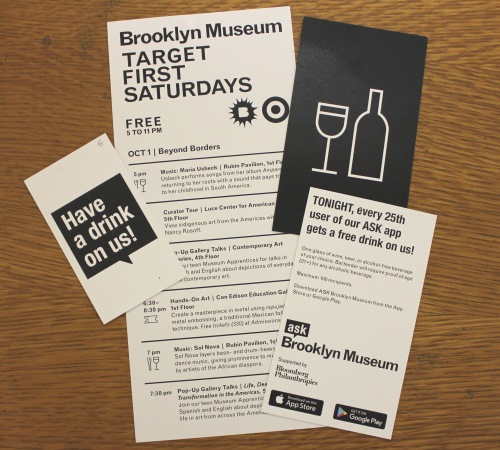
This Thursday, May 9, we are partnering with The Go Game to offer a mobile scavenger hunt for singles. All you have to bring is your sense of adventure (and ideally a mobile device, you need one per team); we’ll take care of the rest. We’ll divide you into teams based on your dating preference, and you get to roam the museum completing missions, meeting new people, and perhaps enjoying a cocktail afterwards. Even if you don’t find “the one,” it will be hard not to have fun playing this game. There are several types of missions, including trivia, location-based puzzles, team photo ops, interacting with planted actors, and more.

I hope you’ll stick around after the game to share you thoughts because Elisabeth, Shelley, and I want to pick your brains. Was the scavenger hunt fun? Would you like more of them, perhaps with different topics or themes? Was it a good way to meet new people? Would you like to see more events like this? More singles events in general? The Go Game is kind enough to work with us for this experimental version, and if you like it, we might partner with them to do more scavenger hunts. So gather your single friends and flap your little wings over to the Museum Thursday at 7!

Posted in Event, Interpretive Materials, Technology | Tagged , | Leave a comment

Fund for African American Art: New Acquisition

As many of you know, the Brooklyn Museum launched the Fund for African American Art a few years ago. This ambitious initiative, which was covered in the New York Times, is designed to help us acquire works created by African American artists before 1945. As someone who just came on board, I’m excited to work with these new acquisitions, many of which are on view now in American Identities, our permanent exhibition devoted to American art on the fifth floor of the museum. For example, this beautiful portrait of actor Leigh Whipper painted by Loïs Mailou Jones was recently installed in American Identities and I had the opportunity to research the artwork to prepare for its debut.

Dans un Café à Paris (Leigh Whipper), 1939

Loïs Mailou Jones (American, 1905-1998). Dans un Café à Paris (Leigh Whipper), 1939. Oil on canvas, 36 x 29 in. (91.4 x 73.7 cm). Brooklyn Museum, Brooklyn Museum Fund for African American Art and gift of Auldlyn Higgins Williams and E.T. Williams, Jr., 2012.1. © Loïs Mailou Jones Pierre-Nöel Trust

When Loïs Mailou Jones painted this portrait, Leigh Whipper was approaching the height of his career as a Broadway and Hollywood actor. He had already become the first black member of the Actors Equity Association in 1920 and, by the end of 1939, he would be famous for his role as Crooks in Lewis Milestone’s critically acclaimed film adaptation of John Steinbeck’s Of Mice and Men. Whipper’s character—a handicapped farmhand ostracized because of his race—served to illuminate the movie’s Depression-era message that American Dream’s promise of economic and social success was impossible.

Leigh Whipper

Photograph of Leigh Whipper © Estate of Leigh Rollin Whipper, Courtesy of Carole Ione Lewis

Faced with the task of learning more about such a fascinating person, I beat a path to the Schomburg Center for Research in Black Culture, which holds the Leigh Whipper papers. Thanks these records, I learned that these two dynamic artists time spent together on February 9, 1939. On that day, Loïs Mailou Jones signed the actor’s signature book: “In memory of a very pleasant afternoon.” With that, she left her signature in the august company of other notables like NAACP leader Walter White. According to Jones’s archives, Whipper also left a caring note in Jones’s guest book: “To the #1 Negro artist (Loïs Jones) who will some day be America’s #1 artist.”

Leigh Whipper’s Signature Book

Leigh Whipper’s Signature Book, Box 1, Folder 1, Leigh Rollin Whipper Papers, Manuscripts, Archives and Rare Books Division, Schomburg Center for Research in Black Culture, The New York Public Library. © Estate of Leigh Rollin Whipper, Courtesy of Carole Ione Lewis

When Jones painted this portrait she had recently returned to teach at Howard University in Washington, D.C. after a year sabbatical spent studying painting in Paris. Perhaps it was nostalgia for France that led Jones to depict Whipper as if seated at a Paris café. At Howard, the artist would enter an intellectual conversation on campus that shaped the discourse of the Harlem Renaissance more broadly. Harlem Renaissance intellectual Alain Locke and “father” of African American art history James Porter were both professors at Howard.

Jones in her Paris studio, 1938

Jones in her Paris studio, 1938. Papers of LMJ/Moorland-Spingarn Research Center, Howard University. © Loïs Mailou Jones Pierre-Nöel Trust

Dans un Café à Paris (Leigh Whipper) reveals the influence of both Locke and Porter. The naturalistic modeling of figure and still-life arrangement of wine bottle and sandwiches follow the academic style that Porter himself employed in his own paintings. Although Locke heralded the flat, egyptianized forms of Aaron Douglas as the epitome of a “racial school of art” inspired by the abstracted forms of African art, Locke also implored black artists to create ennobling portrayals of African Americans—a call that Lois Mailou Jones’s portrayal of a pensive Whipper clearly fulfilled.


Posted in American Art, Newly on View, Recent Acquisitions | 2 Comments

Teaching with a 3D Simulacrum

When Shelley and David brought up the idea of 3D printing, my not-so-inner tech geek and my really-blatantly-outer education geek got pretty excited.  As Shelley mentioned in her previous post, 3D printing is a hot topic in the museum world right now, with some exciting experimentation happening around the world.  Just this week I was at a meeting at the American Museum of Natural History, hearing about some of the exciting 3D printing projects they’re working on with some of their teen programs.

In our use it made sense to start with the Sensory Tour, our monthly tour for visitors with visual impairments as well as anyone who wants to experience art using more than just their sense of sight.  We continually had great success using raised line drawings (they’re just what they sound like; the lines are literally raised from the surface of the paper) to help people feel contours of two-dimensional art.  Why not try the same thing with one more dimension in the mix?

It took some creative thinking and interdepartmental teamwork to figure out an appropriate object and Lost Pleiad hit all the right marks. So, armed with a few 3D prints of Randolph Rogers’ sculpture in our teaching bag, we hit the galleries in the capable teaching hands of Megan Holland and Brigitte Moreno to “explore lines of ink on paper, lines of movement, and lines of poetry in our most recent exhibition, Fine Lines: American Drawings from the Brooklyn Museum.”

So, how did it go, you’re probably wondering?  Did having these touchable models deepen participants’ engagement with the artwork?  Did people walk away feeling like they’d had a satisfying tactile experience with this sculpture?  Is 3D printing going to usurp the place of the statue in museums?  These are all things that were on the minds of the educators as we stepped into this new semi-charted territory.

Fine Lines Sensory Tour

As with most complicated issues, the results were mixed. Visitors were visibly, physically excited by the prospect of our inclusion of this technology.  They paid careful, detailed attention to the surface of the sculpture and all of its contours. They held up the 3D models and compared them to the original sculpture in front of them.

Fine Lines Sensory TourThey looked at the 3D prints from all angles (more than they were able to do with the original, and not unlike the animation commenter Sebastian Heath made from the Thingiverse files David shared in his last post).

During this Sensory Tour, we also passed around samples of marble in various finishes and scarves to think about the contrast between the dense stone and the diaphanous fabric.  People gave them similar amounts of time and attention as they had the 3D prints, but the stone and scarves seemed to spark a wider variety of conversation and brought people’s focus back to the sculpture more quickly.  Not that this is all on the technology, of course, but as educators we’re pretty comfortable using material like the stone samples and scarves to get quality audience conversation going.

The 3D prints are new tools for us to play with, and we need to work with them more to get more comfortable. What are the best kinds of questions to ask people when we put these into their hands?  As blogged about by Alastair Somerville, does it work better to manipulate the image for emphasis, rather than staying strictly true to the original?

In our post-game conversation, the education team behind the Sensory Tours agreed that 3D prints are great tools to help people feel the weight and balance of a sculpture.  They’re “a new way of making lines; a digital brushstroke,” said one educator, and since this month’s Sensory Tour was focused on lines, we couldn’t think of a better place in starting this project.

Posted in Education, Technology | Tagged , | 1 Comment

Join us at #table17

The Brooklyn Artists Ball is coming up next week and it’s an event that we are super excited about; this year’s ball celebrates Brooklyn and our guests will dine at sixteen tables designed especially for the event by Brooklyn artists.

In years past, we’ve shared various aspects of this event via social media mostly in the form of documentation; artists creating tables, guests arriving, and activity happening throughout the night.  This year, we decided to go a more creative route and our Twitter and Instagram feeds will become #table17.

Starting Friday, Brooklyn-based artist Man Bartlett will take over these two feeds and create a project that speaks to how everyone can bring something to the table.  In his own words:

The People’s Table is a virtual collection of images submitted by people around the world in response to the question, “What do you bring to the table?” It is meant to act as a reminder of the multitude of ways that people attribute value to objects and ideas in culture, while simultaneously offering access without regard to significant financial or societal limitations. Anyone with access to an Internet connection can bring themselves, and their vision to the table. Additionally, this collection will be projected for the guests of the 2013 BK Ball, where they will be invited to participate as well.

Man is working with Barry Hoggard to help bring the table to life and we couldn’t be more excited to see it materialize both online and in the building on April 24.  Follow @brooklynmuseum on Twitter and Instagram to join us at #table17.

Posted in Development, Technology | Tagged , | 1 Comment

Replicating a 19th Century Statue with 21st Century Tech

My first exposure to the world of 3D printing took place in 2009 approximately 500 feet under the Earth’s surface in a former missile silo in the Washington state desert. There, three founders of a new Brooklyn-based 3D printer company hosted a workshop on building a 3D printer kit as part of Toorcamp, a nerdy version of Burning Man. At the end of the kit’s 4-hour assembly we printed out some tiny jewelry boxes. At the time 3D printing seemed to me like a novel technology for hackers with lots of potential, but not one I had any specific use for. Four years later, that use was found.

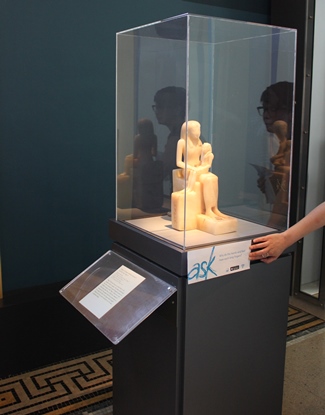
Museum sculptures are an interesting case in accessibility; they exist in a place the public can access but usually aren’t allowed to touch. Most sculpture materials aren’t too smelly or noisy so that limits the sensory experience to sight. However, not everyone has the ability to see, and although special exemptions are occasionally made to allow the visually impaired to touch some sculptures, you can only feel so much of a large object.

Sight includes the ability to expand the size or detail of what you’re looking at by moving closer or further away from the object. This isn’t possible in the two-dimensional web, so the paradigm of pairing a “thumbnail” image with a full-size counterpart became an established method for having both a high-level and up-close view of things. With similar constraints in mind, we’ve utilized 3D scanning and printing to create a “thumbnail” for large sculptures which can be used as a tactial maps of the object’s entire shape.

So how do you go from marble masterpiece to plastic replica? Like 3D printing, 3D scanning has also recently broken out of the expensive-equipment-for-expensive-professions world and into the much more afforable world of hobbyists and institutions with modest budgets. AutoCAD’s 123D Catch is a free download which was launched last year as a way to create 3D models from photos using stereophotogrammetry, which basically means taking a bunch of photos from different angles and letting software figure out how far away stuff in one photo is from stuff in the next.

The conditions those photos are taken in both in the camera and everything surrounding the subject are pretty unforgiving; out of the first eight attempts I’ve made scanning sculptures, only the double Pegasus ended up looking close to what it was supposed to. From these initial attempts and some research, I was able to narrow down the list of things to scan next by whether they met this criteria:

  • Can’t be shiny
  • Can’t be or be inside something transparent
  • Can’t be wiggly/moving (no scanning museum visitors)
  • Must fit in a photo when shot at 30 different angles in a 360 degree radius
  • Must be lit under consistent lighting
  • Can’t have shadows cast on it when shooting
  • Can’t have too many things moving around in the shot (museum visitors indoors, leaves in a windy day outdoors)

When Rachel recommended Randolph Rogers’s The Lost Pleiad, it so perfectly matched the criteria that I saw myself rendering a perfect model from the first scan. Eleven scanning attempts later, I found out:

  • Most cameras try to attempt auto-adjusting exposure when shooting towards a source of light, ruining the scan
  • Bright spotlights on bright white marble create a blur between the edge of the object and the background, ruining the scan
  • Turning off said spotlights without cranking up a camera’s ISO settings lead to slower shutter releases which lead to blurry images, ruining the scan
  • Cameraphones and point-and-shoot cameras don’t have very high ISO settings and I don’t have perfectly steady hands

Scan #11 used a Canon SLR with a manually set white balance, exposure level, and high ISO setting (5000); only auto-focus remained in the camera’s control. Approximately 30 shots in a mostly even perimeter around the statue were taken and re-taken in case if the first take was out of focus along with around 12 overhead shots in a smaller perimeter above and around the statue. After sorting out any blurry photos, the images were uploaded into the Windows version of 123D Catch which shows the angles at which each photo was taken.

123dcatch_windows_600px

Before this is printer-ready, the object had to be cleaned up so that the object has a flat base and doesn’t include stuff in the background picked up by the scan. We used MeshMixer, a free download.

With the texture removed, the remaining mesh looked as though it was melting somewhere that didn’t have gravity with swaths of wall and floor surrounding it (alt+left mouse drag to move around, alt+right mouse drag to zoom in).

meshmixer_plane_cut_600px

I removed floating artifacts is by using the plane cut tool (Edits -> Plane Cut). This was also useful for removing bulges on the surface and slicing a perfectly flat base for the model. The surface of the object was also bumpy and jagged where it should be smooth (arms, torso, etc). The way I solved this was by using the smoothing brush.

meshmixer_smooth_brush_600px

The smoothing brush (Smoothbrush/1) is basically digital sandpaper; For each rough area, I adjusted the size and strength of the brush to match the size and roughness of the surface until it looked more like it’s supposed to. In addition to the removal of defects, the object had to be made “watertight” and have any holes and cracks sealed before being printable.

meshmixer_inspector_600px

With the  inspector tool (Analysis -> Inspector), a floating color-coded sphere pointed to a gap near the bottom of the robe, which was filled by right-clicking the sphere, choosing to smooth the boundary, then left-clicking the sphere.

With the object ready, I exported it as an STL file (File -> Export), a format which most if not all 3D printers can print with. For the printer we use at the Brooklyn Museum (3D Systems Cube v2), the STL file needed to be processed using their Cube Software, also a free download. Using that, I imported the STL file and clicked Heal to double-check the model’s watertightness. Since the model itself was fairly small, I also used the Orient & Scale tool to make it 260% bigger. In Settings, I removed the raft (the Cube uses a special glue that makes printing a platform raft unnecessary) and also removed supports since most of the statue probably wouldn’t need them. Finally, I centered it with the Center icon and hit Build. For simplicity, I built the final .cube file to a USB drive that I could just plug into the printer.

The printer’s on-screen menu has incredibly clear and simple step-by-step directions on how to print, so I won’t repeat them here. Five hours later, the print was completed and looked close enough to be a handheld tactical map of the real McCoy, with only minor amount of overhanging plastic extrusion in areas near the bottom of the robe and under the raised arm.

pleiads_comparison

BONUS: We’re also releasing the STL files under a Creative Commons license for both the Double Pegasus and The Lost Pleiad which you can download and print on your own 3D printer:

Download Double Pegasus (CC-BY 3.0) on Thingiverse
Download The Lost Pleiad (CC-BY 3.0) on Thingiverse

Posted in American Art, Technology | Tagged | 5 Comments

3D Printing for Accessibility

In the last year, we’ve seen a lot happening in the museum space with 3D printing.  The Smithsonian is working on what looks like a enormous project, the Met has a ongoing series of initiatives that look pretty cool, the San Francisco Asian Art Museum has hosted a “scanathon,” and the Art Institute of Chicago has been actively working in the space—just a handful of current projects going on.

As part of an internal program within the Technology department, we’ve started a series of developer led R&D projects; developers propose what they want to experiment with and we set aside time in our busy work week to foster that creativity. In our first round of experiments David Huerta wanted to work with 3D printing; he’s incredibly passionate about this and has been following the 3D printing projects in the industry and beyond.

Double Pegasus

Irwin S. Chanin (American, 1891-1988). Double Pegasus from the Coney Island High Pressure Pumping Station, 2301 Neptune Avenue, Brooklyn, 1936-1937. Limestone, granite, 48 x 24 x 48 in. (121.9 x 61.0 x 121.9 cm). Brooklyn Museum, Lent by The City of New York, L2003.7.2.

I’ll say I needed some convincing; even in asking the team to experiment, my own thoughts tend to take me toward practical applications and, while 3D printing is whiz bang cool and a lot of people had ideas for applications, we just were not seeing much materialize just yet.  But, you never know where a project can lead you, so David started his project by working with the Double Pegasus—an object from Coney Island which greets visitors in our sculpture garden.

Double Pegasus 3D Print

David Huerta with his 3D print of the Double Pegasus.

When he showed up with his 3D print, we were pretty excited and that little physical simulacrum got me thinking about practical applications and how something like this might be used to help our educators with their own goals in helping visitors who are blind or partially sighted.  After speaking with Rachel Ropeik in our Education department, she immediately saw the possibilities and wanted to experiment; David and Rachel are now working on a cross-departmental project to bring 3D printed objects into our series of Sensory Tours.

We consider this a fast, iterative project that aims to get the output right into our visitors hands as we report back on our findings.  We’ve had plenty of bumps in the road—just finding an object that was appropriate for their tour combined with our own ability to capture it was challenging. In the coming week or two, David will blog a lot more on the technical ins and outs of the project and Rachel will be reporting about education goals and visitor reaction. The Double Pegasus is just the start.

Posted in Education, Technology | Tagged , | 2 Comments

The End of the Season

Working together with the ARCE project team we got a great deal accomplished this season in preparing the site to open to visitors. Most of the work consisted of organizing a mass of inscribed and decorated blocks and getting them up off the ground and onto mastabas where they will be both protected from ground water and visible to visitors.


Front before1

Just as a reminder, this photo and the next show the area west of the main roadway just as work was starting. This photograph was taken from atop the Mut Temple’s 1st Pylon and looks northwest. Continue reading

Posted in Egyptian Art | Tagged , , , | 2 Comments

Our last week of excavation

Our last day of excavation was February 28, but we still have work to do. Since we are leaving Luxor next week, this will be our last post from the field. We will do one last wrap-up posting on March 13 once we are back in Brooklyn.


W8 bricks

By mid week, Ayman was turning up some of the clearest and most beautifully laid bricks we have ever encountered. Even when first uncovered, two distinct parallel walls that occupy the full width of the square are clearly visible, with two shorter stubs of brick running off the southern wall. The block of stone between the rows is a door socket, but it seems to be displaced. Continue reading

Posted in Egyptian Art | Tagged , , , | 1 Comment

Old projects, new projects

Julia

Jaap’s wife, Egyptologist Julia Harvey, arrived on February 15, completing this season’s small team. Julia has agreed to take on the pottery, with which she has considerable experience. She already has the first batches sorted and organized. Continue reading

Posted in Egyptian Art | Tagged , , , | Leave a comment

What was that about the WPA?

For her Raw/Cooked exhibition, Supple Beat, Marela Zacarias has installed in the Museum’s lobby and Great Hall four site specific works, each based on one of the Williamsburg Murals. These works seduce on a purely visual level, but don’t stop there. With ties to WPA (Works Projects Administration, part of the New Deal) projects and American art of the 1930s, Supple Beat raises themes of social responsibility, urban renewal, and the role of art in the life of a city.  Zacarias has reimagined the Williamsburg murals—the earliest examples of abstract public art in the United States—as fleshy rebellious objects that will not stay put.  These voluptuous shapes seem to be unfurling and flaunting their colorful surfaces, proudly defying the ‘merely’ decorative function often assigned to mural painting. For example, in the installation 122-192 Bushwick in the Great Hall, a sculpture has slunk off of the wall entirely and wrestles with a television set for our attention, its planes and lines of Paul Kelpe-inspired color flickering in the reflected light of the T.V..

Raw/Cooked: Marela Zacarias

Raw/Cooked: Marela Zacarias, February 1, 2013 through April 28, 2013 (Image: DIG_E_2013_Raw_Cooked_Marela_Zacarias_001_PS4.jpg. Brooklyn Museum photograph, 2013)

Zacarias conceived these objects from the outset to be quasi-organic and anthropomorphic; she shapes and grows her works, golem-like, in her studio, sketching them first with ordinary window screen, plywood, a power drill and screws.  Zacarias has perfected her technique (painting and sanding multiple layers of joint compound before covering all with original painted designs) through rigorous studio practice. She’s also a serious colorist—for Raw/Cooked she spent hours studying the color palettes of the original murals at the Museum—and a bit of an activist who often works with local communities to incorporate the history of spaces, things and people. In Supple Beat each title refers to actual street names and addresses of the Williamsburg Houses. Certain titles have other associations too, like 202-254 Graham,  which stretches toward the mezzanine balcony and reminds Zacarias of the great American choreographer and dancer Martha Graham.

While Zacarias has created both figurative and abstract murals in the past, her interests and studio practice in recent years have shifted towards abstraction and pattern and intersecting histories. Whether she’s inviting participation from local residents on public art projects or advocating for immigrants’ rights, she has track record of combining her aesthetic interests with social and political activism; in Hartford, Connecticut she was the cofounder of Latino/as Contra La Guerra (Latino/as Against the War) and also worked closely with the Regional Coalition for Immigrant Rights in Connecticut. In the case of the Williamsburg Murals Zacarias appreciates that the city of New York and the WPA made a bold move in supporting abstract art, commissioning works by Ilya Bolotowsky, Paul Kelpe, Albert Swindon and Balcombe Greene (little known abstractionists at the time, now revered as an important American artists working in the Constructivist tradition—think forerunners of Color Field and Hard-edge painting.) Against the odds these murals had a life in the Williamsburg Houses, were lost beneath coats of paint in the post-war period, and finally rediscovered and restored in the late-1980s. Supple Beat takes inspiration from the strength and vision of 1930s New Yorkers—artists, urban planners, and regular people who lived through the Great Depression. It also sends out a hopeful note for urban renewal and the future of livable neighborhoods in New York City.

Posted in Contemporary Art | Tagged | Leave a comment

Our first week

Ramesses III sphinxes

According to the late French scholar, Agnes Cabrol, these 3 badly damaged sphinxes sitting east of Chapel D date stylistically to the reign of Ramesses III and probably had originally been part of a sphinx avenue leading north from that king’s temple at the southwest corner of the Isheru. We decided to test that theory this year. Continue reading

Posted in Egyptian Art | Tagged , , , | Leave a comment

Back at Mut – How things have changed!

Our first day at the site this year was February 6, so most of this first posting will be about how the site has changed since we left in January 2011.

In February 2012 the American Research Center in Egypt, with funding from USAID and in co-operation with the Ministry of State for Antiquities, began a project to prepare the Mut Precinct to open to visitors. They are not excavating but rather attempting to control the rampant growth of grasses and reeds at the site and making cosmetic improvements that will make the precinct more accessible to visitors. Under the direction of John Shearman, ARCE’s Associate Director in Luxor, there has been considerable progress.

Theban cliffs

As always, the view from the plane on the trip from Cairo to Luxor was spectacular. This year we flew down the west side of the Nile, over rugged and desolate mountains.


Richard Hassan1[1]    Farouk

First, I’d like to introduce you to the Egyptian colleagues with whom we’ll be working this season. Our MSA inspector this year is Hassan El-Tawab. He and I took a tour of the site on Thursday. Once again, our foreman is Farouk Sharid Mohamed, a friend and colleague of more than 30 years.

Ayman   Abdel Aziz

Farouk’s two sons Ayman (left) and Abdel Aziz will be the Quftis working with us in 2013. They, too, have many years of experience excavating at Mut and other sites and are a delight to work with.

1st court gate

Expeditions at the Mut Precinct have always worked together whenever possible. When the ARCE team asked if we could excavate part of the mound of earth east of the gate in the Mut Temple’s first court (left) so that they could remove a number of large, undecorated blocks from the court, we were glad to oblige. We are hoping to find more of the paving that links the first court to the chapel on the rise of ground to the east.

Tah Gate2

One of the things we want to do this year (a small project) is clear the remaining earth in the square west of the Taharqa Gate where we uncovered paving in 2010. First, though, we need to remove the loose earth along the west baulk to prevent an unwary walker from falling.

New gate   New sign

Now to the changes the ARCE has made. To make it easier to get into the site and and into the Mut Temple they have been laying new paving along the precinct’s main axis. What remains of the ancient paving of the approach to the Mut Temple was badly deteriorated so it was carefully covered with protective material and the new paving laid on a bed of clean sand. Where the paving is in better condition, new blocks are laid around the ancient stones. The new signs for the temple are Egyptian alabaster etched with the images and temple name.

Approach before   Approach 2013

On the left is the road between the precinct entrance and the Mut Temple as it was in January 2011; on the right, the same area today. Quite a difference.

1st Court   2nd Court paving

The first court (left) and second court have been leveled and laid with fine gravel so people can get to the Sakhmet statues. The new paving continues through the second court to the entrance to the rear part of the temple (foreground).

Isheru 2011   Isheru clean

One of the project’s biggest challenges has been to control the growth of reeds around Mut’s Sacred Lake without the use of herbicides. In 2008-2009 the lake was drained so that the Johns Hopkins University expedition, directed by Dr. Betsy Bryan, could excavate along its shores. Once the lake was allowed to refill, the reeds grew back almost as thickly as ever; the photo on the left was taken in January 2011. The method ARCE has used seems to be working (right) without making the Isheru inhospitable to the many types of birds who feed there. In the background on the right is the pathway the ARCE team has built around the lake to allow visitors to enjoy its beauty.

TA S before   TA S after

To make it easier to get to the pathway on the east side of the Mut Temple (still under construction), the ARCE team has built shallow stairs leading south from the junction of Mut’s First Pylon (right) and Temple A (left). We appreciate the stairs, too, as we are doing some work in this area. All in all, navigating the site’s monuments is much less of a challenge than it was before.

Posted in Egyptian Art | Tagged , , , | 1 Comment

Armed with Input

As you may recall, we kicked-off a visitor study about Connecting Cultures back in May with an updated approach based on a bit of trial-and-error in July. We wrapped up the study in August and it’s taken me awhile to crunch all the data and wrap my mind around what it all means—and honestly, I’ve only scratched the surface.

Connecting Cultures

During the run of the study, 62 people completed our interviews and 59 completed surveys. I am happy to report, that generally speaking, the exhibition works. That is, most of you (85%!) recognized the main idea. This tells me that our didactics—our labels and wall text—are clearly communicating what we hope you will take away from the exhibition. The 85% includes both survey takers, who were able to select from multiple choices, and interviewees, who had to put the main idea in their own words. Survey participants could only select one choice from the options, but those interviewed were free to articulate the main idea in any way they wanted. What I find interesting is that most people had more than one answer, which makes me think that most visitors are clearly finding the meaning we are presenting, but also coming up with their own meaning—which is great! Our presentation is just one interpretation and should be treated as such. The more visitors that can find their own meaning, the better.

In addition to wondering if you recognize the main idea, we also wanted to know how you were using the exhibition. Our hope is that it serves as a kind of template to your experience. On the most basic level, we hope it gets you thinking about art in new ways.  On a slightly more complication level, we hope that it encourages you to find and explore cross-cultural and cross-collection connections throughout the other galleries.  In this arena, we could do a little better. Only 45% of participants (combined survey and interview) used the exhibition in this way and for most of them it was more “thinking about art in new ways” than “find and explore connections”.  Still, I am encouraged by the enthusiastic responses of some visitors who really picked up on this idea and ran with it. After all, it’s a suggestion not a mandate.

On a large scale, our next steps include identifying ways we can underscore the template function of Connecting Cultures by providing additional opportunities throughout the galleries to make connections (for those that want it). Now we are armed with input from you as we update some of our long-term, collections-based installations.

On a small scale, I would like to spend more time combing through the rest of the data. Other questions asked included what visitors want to know about works on display, how long they spend (or really think they spend) looking at a work of art, and more. Though the study answered some immediate questions about Connecting Cultures, I have a feeling it will spark even more questions once I can really sink my teeth into all the information available.

A big thank you everyone who participated—your time and effort in letting us survey your experiences helps us improve the visit for everyone.

Posted in Interpretive Materials | Tagged , | 1 Comment

Out of Africa, 1926: Malvina Hoffman and a Senegalese Soldier

In his newly opened installation Rumination, Raw/Cooked artist Duron Jackson has included Senegalese Soldier(28.385), a remarkable work by the early-twentieth-century sculptor Malvina Hoffman.

Placed in close proximity with Jackson’s Blackboard Paintings—abstracted aerial views of American prisons—Hoffman’s larger than life-sized bust portrait stands in for the historical black male body, and by extension, the slave trade. Jackson has created a compelling space in which to contemplate race and culture, and Senegalese Soldier has an important backstory. The Museum purchased it and Hoffman’s Martinque Woman (28.384, which was prominently featured in our recent exhibition Youth and Beauty: Art of the American Twenties) in 1928, almost immediately after they were finished. Both are absolutely exceptional works in Hoffman’s career for two reasons that I will explain after this background on the artist.

Hoffman, Martinique Woman

Malvina Hoffman (American, 1885-1966). Martinique Woman, 1928. Black metamorphic stone, 22 x 14 1/4 x 15 1/4 in. (55.9 x 36.2 x 38.7 cm). Brooklyn Museum, Dick S. Ramsay Fund, 28.384. © Estate of Malvina Hoffman

If you’ve heard of Malvina Hoffman, you may have seen the famous photograph of her astride the shoulders of one of her monumental figures with a chisel in hand wearing her signature velvet tam on her head. Hoffman was undaunted in her pursuit of a career as a sculptor at a time when it was still an unusual one for women. She tapped her family’s close ties among New York’s cultural elite in order to achieve her goal, seeking lessons and critiques from several prominent New York sculptors. But Hoffman set her sights high and in 1910 took off for Paris with hopes of studying with the great Auguste Rodin—and she did, eventually, receiving critiques and earning status as an assistant. Although Hoffman never adopted his dynamic style, (Rodin’s bronzes suggest movement), she was inspired to pursue similar subjects, including lovers and dancers.

The outbreak of World War I in 1914 forced Hoffman back to New York and changed her outlook on life and art. In 1919 she served as director of the National and Foreign Information Service of the Red Cross in New York and also made a life-altering trip through the Balkans with the American Relief Administration. Unable to happily continue her routine of work, in 1926 she embarked on a trip to North Africa to retune her eye through experiences which were entirely new to her.

Hoffman, Senegalese Soldier

Malvina Hoffman (American, 1885-1966). Senegalese Soldier, 1928. Black stone, 20 x 10 x 15 in. (50.8 x 25.4 x 38.1 cm). Brooklyn Museum, Dick S. Ramsay Fund, 28.385. © Estate of Malvina Hoffman

Which leads us to the Senegalese Soldier.  Early on, in Tunisia, Hoffman traveled south from Tunis by train to Gabé where, on arrival, she encountered Senegalese troops under the command of a French colonial officer. Her later account is tinged with the language of exotification so common in Eurocentric descriptions of African places and people. Finding the features of the soldier “startlingly impressive,” Hoffman exercised her privilege as a westerner in the French colony to gain access to the soldiers whose physiognomy interested her—an arrangement only marginally redeemed by her interviews to determine their willingness to sit for her. Interestingly, however, in the clay model for Senegalese Soldier, Hoffman agreed to the man’s conditions that she never show the work in Africa nor ever associate his name with it.

Hoffman thus began her focused attention on the portrayal of racial types—and that is the first reason the two Brooklyn works are exceptional. The second is that in producing the marbles in fine, black stone, she broke with her previous naturalistic style and adopted a monumentality and idealism in keeping with a broader aesthetic trend in the 1920s—one that celebrated and perfected physical presence. And herein lies the second reason for their exceptional status: these works constituted an effort by Hoffman to modernize her aesthetic.

Hoffman Getty

Malvina Hoffman, Les races humaines, Musée d'Ethnographie du Trocadero de Paris (November 1933). Malvina Hoffman papers, Research Library, The Getty Research Institute, Los Angeles (850042). © Estate of Malvina Hoffman

Just how unusual these works are in her production has been obscured by their association with the much larger commission she undertook in 1930 for Chicago’s Field Museum. It involved the production of nearly 100 bronze sculptures of the “races of man” for a physical anthropology display similar to a type popular at the time. As Marianne Kinkel discusses in great detail in her publication Races of Mankind: The Sculptures of Malvina Hoffman (University of Illinois Press, 2011), these installations were underpinned by theories about fixed racial identity—based in everything from geography to hormonal patterns. Hoffman won the commission through her social connections and, for her part, ignored much of the current science in producing the works. As Kinkel explains, she rejected ideas about establishing racial types through “composites” of many individuals. She based most of her sculptures on anthropological photographs (she personally traveled only to Asia for the global project) and stated that racial identity was better defined by gesture and action.

Her works for the commission are as photographic as bronzes can be. The differences between these literal works and Brooklyn’s two impressive heads did not stop her from exhibiting them together in several exhibitions, including one in Paris’s Trocadero Museum of Ethnology in 1933.

Posted in American Art, Contemporary Art | Tagged | Leave a comment

Yoko Ono’s Wish Tree

Since the 1990s, Yoko Ono has created her work Wish Tree in locations all over world.   In honor of Ono’s acceptance of the Brooklyn Museum’s 2012 Women in the Arts Award, we have installed this work in our third floor elevator lobby through January 6, 2013.  Additionally, in a rare opportunity to see an extended interview with Ono, we recorded the conversation I had with her during the program for the tenth annual Women in the Arts Luncheon, which took place at the museum on November 15.

A collaborative project between the artist and her audience, Wish Tree is Ono’s open invitation to viewers to write their own wishes on small tags that the writer then hangs on the live tree – making a kind of living monument to all our dreams, big and small.  Ono has recounted that as a child in Japan she would write wishes on small pieces of paper which she then attached to the branches of flowering trees in the courtyard of a temple.

Yoko Ono's Wish Tree

Yoko Ono's Wish Tree installed on our third floor.

Over the course of our exhibition, as the tree fills with wishes, the museum will occasionally collect the tags and at the end of the show, all the cards are returned to Ono, to be buried, unread, around her Imagine Peace Tower, a 2007 installation in Reykjavík, Iceland, dedicated to the memory of her late husband John Lennon.  More than a million people have shared their wishes with Yoko Ono, and we invite you to add your dreams.  As the artist has said, “All my works are a form of wishing.  Keep wishing while you participate.”

Posted in Contemporary Art, Elizabeth A. Sackler Center for Feminist Art | Tagged | 1 Comment